Best Dog Food for English Labs: A Buying Guide
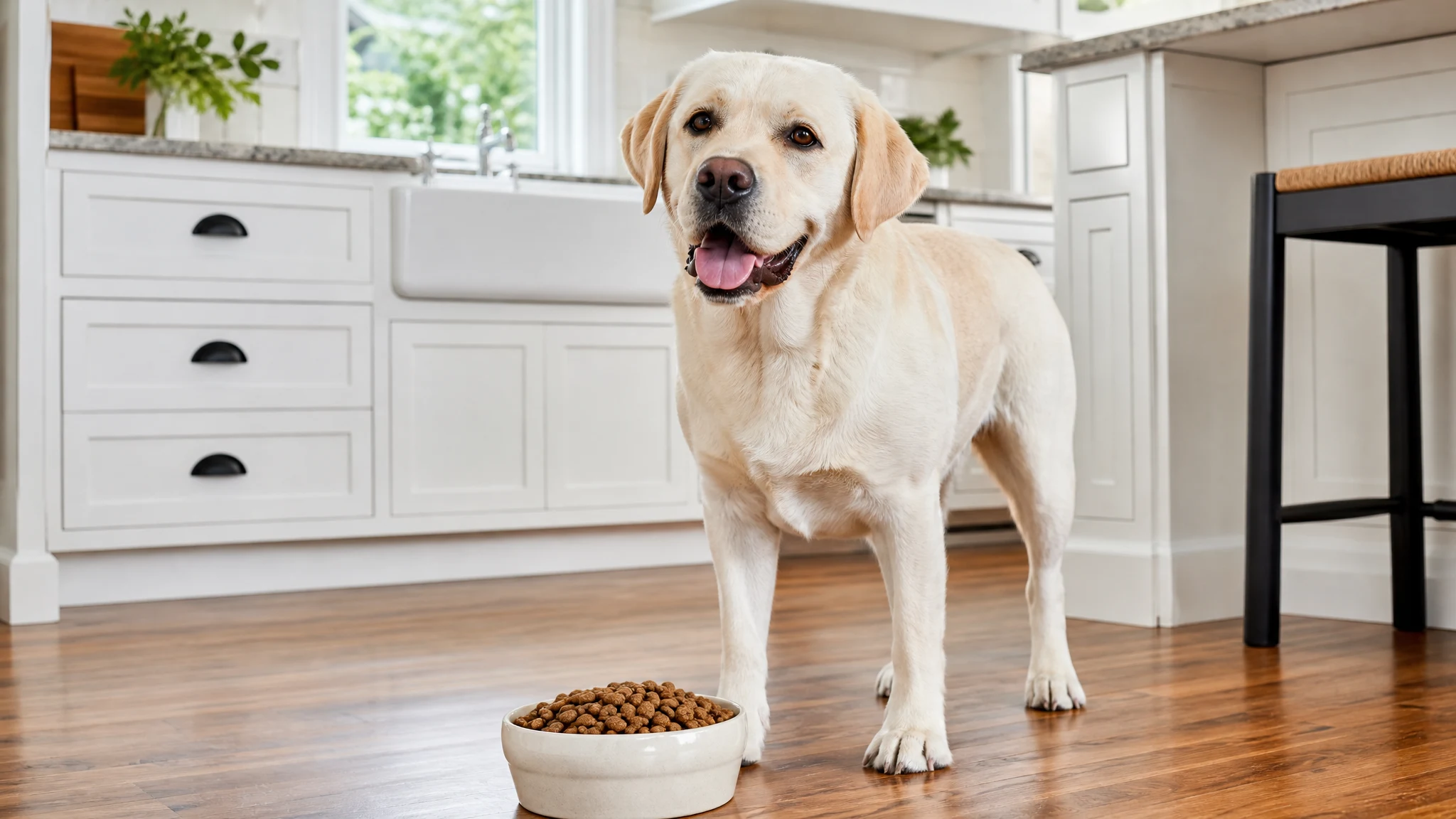
General nutrition information compiled from product labels and published sources, not veterinary advice. Your veterinarian is the right person to choose a diet for your dog, especially one with a health condition.
Owners who ask about the best dog food for English labs are usually asking one thing: how do I pick a food that fits my dog? The answer starts with the label, not the front of the bag.
This guide walks through the steps. It uses label data from the brands' own pages. We compared labels only. We did not run feeding trials or taste tests, and we are not ranking foods by how dogs liked them.
A note on the term "English Lab"
The Labrador Retriever Club, the AKC parent club, publishes one breed standard for the Labrador Retriever. It describes males at about 65 to 80 pounds and females at about 55 to 70 pounds, in working condition. It gives males 22.5 to 24.5 inches at the withers and females 21.5 to 23.5 inches.
"English" is a common informal label, and the standard does not set separate food needs for it. If you want to know how your own dog's line is described, ask the breeder or the club. Feed the dog in front of you: its age, its weight and its body condition.
What you need before you start
- Your dog's age and current weight, from a recent vet visit if possible.
- The bag or the brand page of the food you are considering.
- A notepad or phone to write down the label details.
- A measuring cup, and a kitchen scale if you have one.
- Your veterinarian's phone number or portal, for the final decision.
Step 1: Match the food to your dog's life stage
Every complete food carries an AAFCO statement. It says whether the food is for growth, adult maintenance or all life stages. Find that sentence first. If it does not match your dog's stage, set the food aside.
Some brands base the statement on feeding tests. Others say the food is formulated to meet the AAFCO nutrient profiles. Both are legitimate label wordings. They are different claims, so note which one you are looking at.
Step 2: For puppies, look for the large-size wording
This step matters most for Labrador puppies. Foods that claim growth or all life stages carry one of two phrases. One is "including growth of large-size dogs (70 pounds or more as an adult)." The other is "except for growth of large-size dogs (70 pounds or more as an adult)." Whole Dog Journal explains these phrases in its guide to nutritional adequacy statements.
Male Labradors fall at or above that 70 pound mark, so choose the "including" version for a puppy. Whole Dog Journal also reports that large-breed growth foods cap calcium at 1.8 percent on a dry matter basis, and that large-breed puppies should not get extra calcium. Ask your veterinarian before adding anything to a puppy's bowl.
Several foods on the market say "except" on the label, so check the wording rather than assuming. VICTOR's Hi-Pro Plus and its Chicken and Rice Formula Pate both carry that exception on their brand pages.
Step 3: Read the first five ingredients
Ingredients are listed by weight before cooking. The first five tell you the main building blocks. They do not tell you quality, and they do not tell you whether a food suits your dog.
For example, Hill's Science Diet Adult Large Breed lists chicken, cracked pearled barley, brown rice, brewers rice and whole grain wheat. Royal Canin's Labrador Retriever Puppy lists chicken by-product meal, brewers rice, brown rice, corn and wheat gluten. A "meal" or "by-product meal" is not automatically better or worse. It is a different ingredient form, so judge the whole label.
Step 4: Compare protein, fat and calories on the same basis
Labels report numbers in different ways. Hill's pages show dry matter averages and give no guaranteed minimum. Royal Canin and VICTOR show guaranteed analysis figures. Do not set a dry matter average side by side with a guaranteed minimum and call one higher.
The table below uses the figures as each brand's page presents them.
| Food | Life stage on label | Protein | Fat | Calories | First ingredient |
|---|---|---|---|---|---|
| Hill's Science Diet Puppy Large Breed Chicken & Brown Rice | Growth, large breed | 26.7% (dry matter average) | 15.4% (dry matter average) | 387 kcal per cup | Chicken |
| Royal Canin Labrador Retriever Puppy | Growth, including large size dogs | 31.0% | 12.0% | 307 kcal per cup (calculated) | Chicken by-product meal |
| VICTOR Hi-Pro Plus Large Breed Puppy | All life stages, including large dog growth | 30% | 14.0% | 365 kcal per cup | Chicken |
| Hill's Science Diet Adult Large Breed Chicken & Barley | Adult maintenance | 23.8% (dry matter average) | 15% (dry matter average) | 365 kcal per cup | Chicken |
| Hill's Science Diet Adult 6+ Large Breed Chicken Meal, Barley & Rice | Mature adult maintenance | 18.7% (dry matter average) | 13.5% (dry matter average) | 352 kcal per cup | Chicken meal |
| VICTOR Senior Healthy Weight | Adult maintenance | 27.0% | 11.5% | 360 kcal per cup | Beef meal |
Brand pages: Hill's Puppy Large Breed, Royal Canin Labrador Retriever Puppy, VICTOR Hi-Pro Plus Large Breed Puppy, Hill's Adult Large Breed, Hill's Adult 6+ Large Breed and VICTOR Senior Healthy Weight.
Royal Canin also makes a Labrador Retriever Adult formula. The figures we found for it conflicted between listings, so check the numbers on the bag or with the brand before you compare. For a longer comparison, see our label-by-label comparison of foods for Labs.
Step 5: Think about calories, because Labs love to eat
Calorie density varies a lot. Royal Canin's puppy formula lists 307 kcal per cup, while Hill's puppy formula lists 387. The same cup gives a different amount of energy, so a feeding guide from one food cannot be used for another.
Weight is a real concern for this breed. A study in Cell Metabolism (Raffan et al., 2016), listed by the MRC Epidemiology Unit, reported a deletion in the POMC gene in 12 percent of the Labradors studied. It was more common in assistance dogs than in pets, and the study links the gene to food motivation and obesity. Food cannot change a gene, and a label cannot tell you whether your dog carries it. If your Lab always seems hungry, tell your veterinarian and let them guide the plan.
Step 6: Use the feeding guide as a starting point
Start with the label's feeding guide and the dog's current weight. Treat it as a first estimate. Hill's pages say to adjust amounts to maintain optimal weight and to ask your veterinarian if you are unsure. Royal Canin's guidance says the chart is only a guide and amounts vary with temperament, activity and environment.
Measure each meal. Check your dog's body condition every few weeks, and count treats as part of the day's food.
Step 7: Transition slowly and check with your veterinarian
Royal Canin advises moving to a new food gradually over at least 7 days. VICTOR advises 7 to 10 days. Mix a little more of the new food into the old each day.
Then bring your choice to your veterinarian. They know your dog's history and decide what is right for an individual dog. Prescription diets are only something a veterinarian prescribes.
Tips and common mistakes
- Skipping the adequacy statement. A front-of-bag claim is marketing. The AAFCO sentence is the part to read.
- Feeding an "except large-size growth" food to a puppy. Check the exact wording.
- Comparing mismatched numbers. Dry matter averages and guaranteed analysis are not the same thing.
- Adding calcium to a puppy's diet. Whole Dog Journal says large-breed puppies should not get supplemental calcium.
- Following the bag chart forever. Adjust to your dog's body condition, with your veterinarian's help.
- Assuming grain-free is better. The FDA has investigated a possible link between certain diets and canine dilated cardiomyopathy (DCM). Its last public update on the page was December 23, 2022, and it said it did not plan more updates until there is meaningful new scientific information. The Labrador Retriever Club lists diet-associated DCM as a research topic. Ask your veterinarian about it. Our comparison does not rely on grain-free status.
- Switching foods suddenly. It often upsets the stomach.
What to expect
A well-matched food, fed in measured amounts, may help your dog hold a steady weight and eat with a consistent appetite. Many owners also see firm stools and steady energy within a few weeks, though results vary from dog to dog.
No food prevents or treats hip dysplasia, elbow dysplasia or any other condition. The Labrador Retriever Club lists hip and elbow evaluations among its recommended health clearances, and its page gives no diet guidance for them. If your dog has a health concern, your veterinarian decides what to feed.
Sources
- Labrador Retriever Club, Labrador Breed Standard
- Labrador Retriever Club, Health Issues
- Whole Dog Journal, In the Fine Print: Nutritional Adequacy Statements
- Whole Dog Journal, Best Large Breed Puppy Food
- Cell Metabolism 2016 (Raffan et al.), MRC Epidemiology Unit publications page
- FDA CVM, Investigation into Potential Link between Certain Diets and Canine DCM
- Hill's Pet Nutrition
- Royal Canin USA
- VICTOR Super Premium Pet Foods