Best Food for Black Labs: Budget vs Premium Options
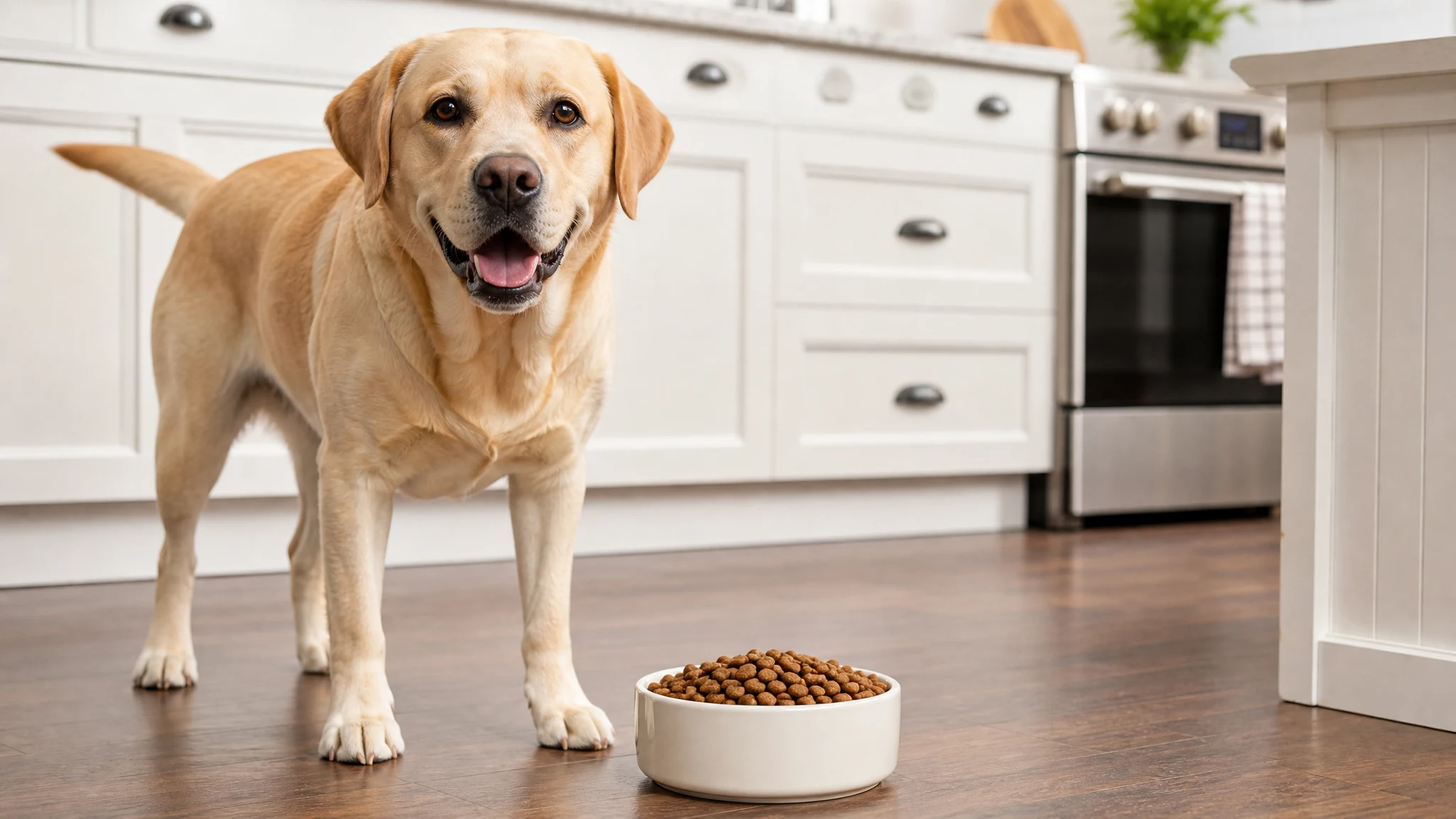
General nutrition information compiled from product labels and published sources, not veterinary advice. Your veterinarian is the right person to choose a diet for your dog, especially one with a health condition.
Choosing the best food for black labs comes down to a few label details, not a coat color and not a price tag. This guide walks you through a repeatable way to compare a lower-cost food with a premium one for your Labrador Retriever.
We compared label data only. We did not run feeding trials or taste tests, and we are not claiming any food works better than another for your dog. Nothing in the sources we used says a black Labrador needs different nutrition from a yellow or chocolate one, so a veterinarian is the right person to confirm what fits your dog.
What You Need Before You Start
- Your dog's current weight and age, ideally from a recent vet visit.
- The bag or the brand's product page for each food you are considering.
- A kitchen scale or a standard measuring cup.
- A notepad or spreadsheet for the numbers.
- A calculator for comparing cost per day, using prices you check yourself with the brand or your own store.
We do not list prices here. Prices change and vary by seller, so any number we gave would be a guess. Add your own price column to the notes you build below.
Step 1: Know the Dog You Are Feeding
The Labrador Retriever Club (the AKC parent club) lists its breed standard weights as roughly 65 to 80 pounds for males and 55 to 70 pounds for females, in working condition. That puts many males at or above the 70 pound line AAFCO uses for large-size dogs.
That matters most for puppies. The next steps explain why.
Also note your dog's life stage: puppy, adult or mature adult. The Labrador Retriever Club's health page does not give diet guidance for hip or elbow dysplasia, so do not expect a bag to settle those questions. Ask your veterinarian.
Step 2: Read the AAFCO Statement First
The AAFCO adequacy statement tells you which dogs a food is built for. Look for three things: whether it says complete and balanced, which life stage it names, and how it treats large dogs.
According to Whole Dog Journal, foods that claim growth or all life stages carry one of two phrases. One says the food includes growth of large-size dogs (70 pounds or more as an adult). The other says it is except for growth of large-size dogs. The second kind is not suitable for large-breed puppies.
Whole Dog Journal also reports that large-breed puppy foods cap calcium at 1.8 percent on a dry matter basis, and that large-breed puppies should not get supplemental calcium. Treat this as a reason to ask your vet before adding anything to a puppy's bowl.
Here is where this changes a budget decision. VICTOR's Hi-Pro Plus and its Chicken and Rice Formula Pate both state they are for all life stages or growth and maintenance except growth of large-size dogs. A lower cost does not help if the statement rules out your puppy.
Step 3: Compare Protein, Fat and Calories
Next, line up the numbers. The table below uses the brand pages. Hill's lists dry matter averages rather than guaranteed minimums, so those figures are not directly comparable to the guaranteed minimums from Royal Canin and VICTOR. Treat the table as a map for your own checking, not a ranking.
| Food | AAFCO statement, in brief | Protein | Fat | Calories per cup |
|---|---|---|---|---|
| Hill's Science Diet Puppy Large Breed Chicken & Brown Rice | Growth (feeding tests) | 26.7% dry matter avg. | 15.4% dry matter avg. | 387 |
| Hill's Science Diet Adult Large Breed Chicken & Barley | Adult maintenance (feeding tests) | 23.8% dry matter avg. | 15% dry matter avg. | 365 |
| Hill's Science Diet Adult 6+ Large Breed Chicken Meal, Barley & Rice | Adult maintenance (feeding tests) | 18.7% dry matter avg. | 13.5% dry matter avg. | 352 |
| Royal Canin Labrador Retriever Puppy | Growth, including large-size dogs | 31.0% min. | 12.0% min. | 307 (calculated) |
| VICTOR Hi-Pro Plus Large Breed Puppy | All life stages, including large-size growth | 30% min. | 14.0% min. | 365 |
| VICTOR Senior Healthy Weight | Adult maintenance | 27.0% min. | 11.5% min. | 360 |
| VICTOR Hi-Pro Plus | All life stages except large-size growth | 30.0% min. | 20.0% min. | 406 |
Two details stand out. Calorie density ranges from 307 to 406 kilocalories per cup in this set, so a cup of one food is not a cup of another. And a high-fat, high-calorie formula like Hi-Pro Plus is described by VICTOR as an active-dog food, which is a different job from keeping a pet Lab lean.
Royal Canin's adult Labrador formula is not in the table. The figures we found for it conflicted between listings, so check the bag or Royal Canin directly before relying on any number.
Step 4: Read the First Ingredients Honestly
The first five ingredients show what the recipe is built from by weight, before cooking. They do not show quality, and they do not show how a particular dog will do on the food.
For example, the Hill's Large Breed Puppy lists chicken, brown rice, whole grain oats, chicken meal and cracked pearled barley. Royal Canin's Labrador Puppy starts with chicken by-product meal, brewers rice, brown rice, corn and wheat gluten. VICTOR's Large Breed Puppy starts with chicken, chicken meal, brown rice, whole grain millet and whole grain sorghum.
None of these is grain free. Nom Nom's Chicken Cuisine is a grain-free fresh food. The FDA has been investigating a potential link between certain diets and canine dilated cardiomyopathy (DCM). Its last public update on that page was December 23, 2022, and it said it did not plan more public updates until there is meaningful new scientific information. That is not a verdict on any food. If you are weighing a grain-free diet, ask your veterinarian.
Step 5: Weigh Budget Against Premium Using the Label
Now compare cost against what the label gives you. Fill in your own price per bag, then divide by the days a bag lasts at the label's starting amount.
Some questions that help:
- Does the statement match your dog's life stage and size?
- How many calories per cup are in it, and how many cups would your dog eat?
- Is the food's form practical for you: dry, wet or fresh?
Fresh foods are a good example of how form changes the math. Nom Nom lists 244 kilocalories per cup (calculated) for Chicken Cuisine, and JustFoodForDogs lists 43 kilocalories per ounce for its Chicken & Rice Recipe. Both state they meet AAFCO profiles for all life stages, including growth of large-size dogs. The label says nothing about how they would fit your budget, so check with each brand.
Premium and budget are price labels, not label-data categories. In our comparison, a higher price did not change what the AAFCO statement requires.
Step 6: Set a Starting Amount and Watch Your Dog
Brand feeding guides are starting points. Hill's says to adjust amounts as needed to maintain optimal weight and to ask your veterinarian if you are unsure. Royal Canin's adult guide notes amounts may vary with temperament, activity level and environment.
Labradors deserve extra care here. A 2016 study in Cell Metabolism (Raffan et al.), listed by the MRC Epidemiology Unit, reported a POMC gene deletion linked to obesity and food motivation. The study found the deletion allele in 12 percent of the Labradors it looked at, and it was more common in assistance dogs than in pets. If your Lab acts hungry all the time, that may or may not relate to this. Your veterinarian can help you weigh it.
Use a scale or a measuring cup every time. Eyeballing a scoop is where extra calories tend to creep in.
Step 7: Switch Foods Gradually
VICTOR suggests transitioning over 7 to 10 days, and Royal Canin suggests at least 7 days. Mix a little of the new food into the old, and increase the new portion each day.
Tips and Common Mistakes
- Choosing by coat color. We found no label data that changes with coat color. Choose by life stage, size and your vet's advice.
- Feeding an adult food to a growing puppy. Check that the statement covers growth and, for a large-size puppy, includes large-size dogs.
- Using the cup as the unit. Compare calories per cup, because they differ widely.
- Adding calcium. Whole Dog Journal advises against supplemental calcium for large-breed puppies.
- Treating a food as a medical tool. No food on this page is claimed to prevent or treat any condition. Prescription diets are something only a veterinarian prescribes.
- Trusting a single number. Dry matter averages and guaranteed minimums are not the same measure.
What Results to Expect
If a food suits your dog, you may notice steady energy, regular stools and a stable body condition over several weeks. These are things to watch, not promises. Every dog differs, and a food that is a good match on paper may still not work for your dog.
If your dog gains weight, loses weight, or has digestive upset, talk to your veterinarian before changing the diet again.
For a longer product-by-product look at the same kind of data, see the best dog food for Labs, compared label by label.
Sources
- Labrador Retriever Club, Labrador Breed Standard
- Labrador Retriever Club, Health Issues
- Whole Dog Journal, In the Fine Print: Nutritional Adequacy Statements
- Whole Dog Journal, Best Large Breed Puppy Food
- FDA CVM, Investigation into Potential Link between Certain Diets and Canine DCM
- Cell Metabolism 2016 (Raffan et al.), MRC Epidemiology Unit
- Hill's Science Diet Puppy Large Breed
- Hill's Science Diet Adult Large Breed
- Hill's Science Diet Adult 6+ Large Breed
- Royal Canin Labrador Retriever Puppy
- VICTOR Hi-Pro Plus Large Breed Puppy
- VICTOR Senior Healthy Weight
- VICTOR Hi-Pro Plus
- Nom Nom Chicken Cuisine
- JustFoodForDogs Chicken & Rice Recipe