Best Puppy Food for Labrador Retriever Puppies
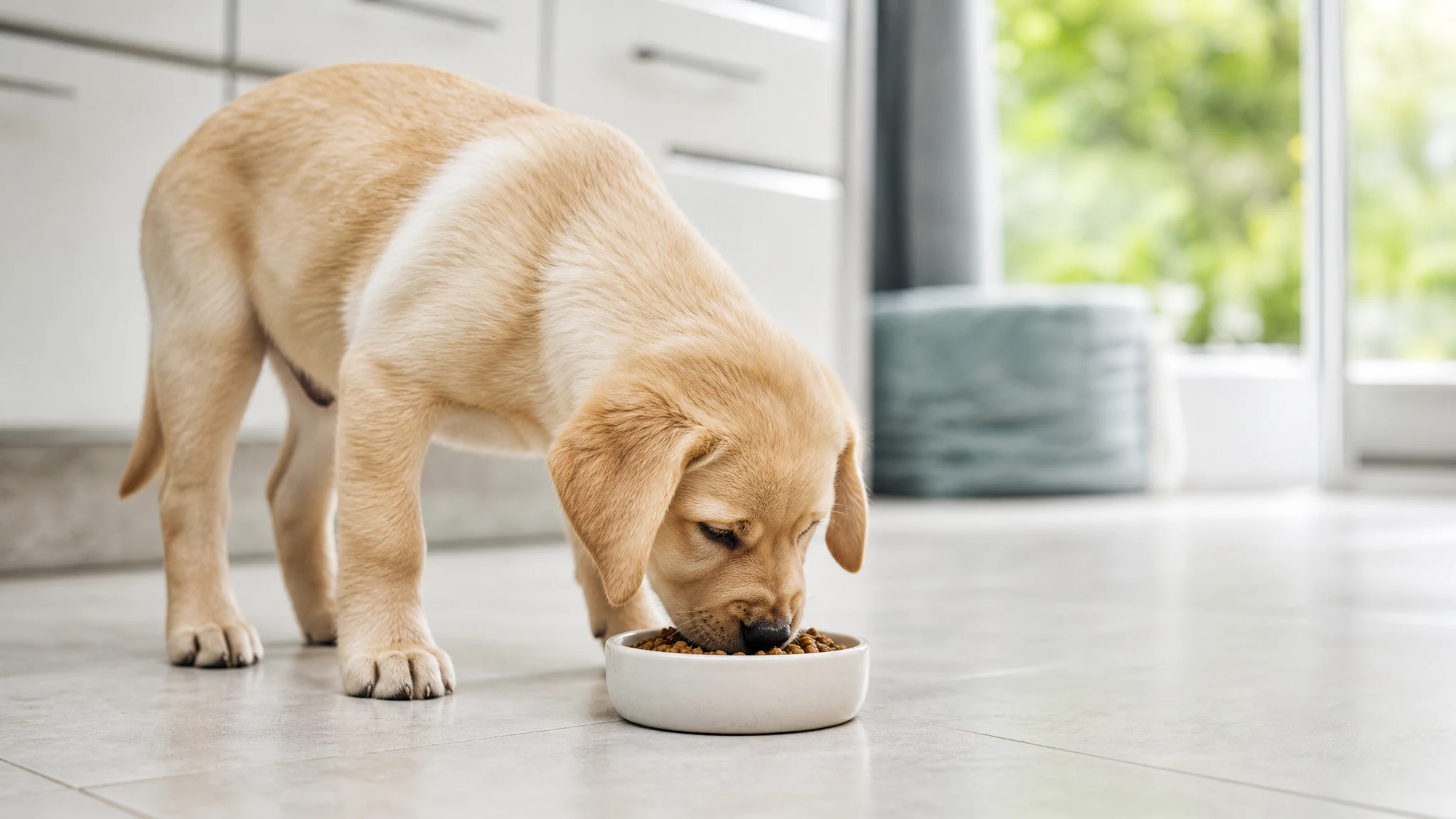
General nutrition information compiled from product labels and published sources, not veterinary advice. Your veterinarian is the right person to choose a diet for your dog, especially one with a health condition.
Choosing labrador retriever puppy food is mostly a matter of reading the fine print on the bag. Marketing words like "premium" and "natural" tell you little. The nutritional adequacy statement, the ingredient order and the calorie count tell you much more.
This guide explains what to check and how to compare. It also walks through five growth formulas whose labels say they cover a Labrador-sized puppy. It is not a ranking of winners, because a label cannot tell you how your puppy will do on a food.
How we compared these foods
We compared label data published by each brand: the nutritional adequacy statement, the first ingredients, the protein, fat and fiber figures, and the calories per cup. We did not run feeding trials or taste tests, and we have not fed these foods to any dog. Nothing here says one food is better for your puppy than another.
Only foods whose statements cover growth made the cut. Because of the Labrador's adult size, we also required that the label either includes growth of large-size dogs or is made for large-breed puppies. That rule is explained below.
Why a Labrador puppy needs a large-size growth label
The Labrador Retriever Club breed standard describes the breed as medium-sized. It lists adult males at about 65 to 80 pounds and females at about 55 to 70 pounds, in working condition. Males sit at or above the 70 pound line that pet food labels use to define a large-size dog.
That line matters. According to Whole Dog Journal's explanation of nutritional adequacy statements, foods that claim growth or all life stages carry one of two phrases:
- "including growth of large-size dogs (70 pounds or more as an adult)", which means the food is suitable for large-breed puppies.
- "except for growth of large-size dogs (70 pounds or more as an adult)", which means it is not.
Whole Dog Journal also reports that large and giant breed puppy formulas cap calcium at 1.8 percent on a dry matter basis, and that large-breed puppies should not get supplemental calcium. It describes the right choice as a complete and balanced growth food labeled for large-size dogs.
The practical rule is simple. A bag labeled "all life stages" is not automatically right for a Labrador puppy. Look for the phrase "including growth of large-size dogs", or a large-breed puppy formula with a growth statement.
What to look for: quality indicators on the label
1. The adequacy statement
Find the sentence that begins with something like "formulated to meet the nutritional levels established by the AAFCO Dog Food Nutrient Profiles for...". It should say growth or all life stages, and it should include the large-size wording. Some foods instead say that animal feeding tests substantiate the claim. That is a different method of proving the food is complete, and it is a legitimate one.
2. The first ingredients
Ingredients are listed by weight before cooking, so the first five tell you the general character of the food. Look for a named animal protein, such as chicken or chicken meal, near the top. Be aware that fresh meat weighs a lot of water, so a meat meal can contribute more protein than its position suggests. You cannot judge the quality of a recipe from the list alone.
3. Protein, fat and fiber figures
Compare foods in the same form. Fresh and frozen foods contain a lot of moisture, so their percentages look much lower than kibble even when the nutrition is balanced. Also check what the number means. Some brands publish guaranteed minimums. Hill's publishes dry matter averages for the foods below, which are not guarantees.
4. Calories per cup
This is the figure most people skip, and it matters for a breed known for food motivation. Calories per cup varies widely among the foods below, from 244 to 387 kcal per cup. The same cup of two different foods can mean very different intakes.
5. Kibble size
None of the brand pages we reviewed gives kibble dimensions. Royal Canin describes its Labrador kibble as donut-shaped. VICTOR says its large-breed puppy kibble is an appropriate size for large breeds. If size matters to you, ask the brand.
Five growth formulas compared by label
The table shows the label data each brand publishes. Percentages for dry foods are not comparable with the fresh foods, because of moisture. Hill's figures are dry matter averages. The other figures are as published by the brand.
| Food | Form | First five ingredients | Protein / fat / fiber (%) | Calories |
|---|---|---|---|---|
| Royal Canin Breed Health Nutrition Labrador Retriever Puppy | Dry | Chicken by-product meal, brewers rice, brown rice, corn, wheat gluten | 31.0 min / 12.0 min / 3.8 max | 307 kcal ME per cup (calculated) |
| Hill's Science Diet Puppy Large Breed Chicken & Brown Rice | Dry | Chicken, brown rice, whole grain oats, chicken meal, cracked pearled barley | 26.7 / 15.4 / 2.8 (dry matter averages) | 387 kcal per cup |
| VICTOR Hi-Pro Plus Large Breed Puppy | Dry | Chicken, chicken meal, brown rice, whole grain millet, whole grain sorghum | 30 min / 14.0 min / 6.0 max | 365 kcal per cup |
| Nom Nom Chicken Cuisine | Fresh | Chicken, sweet potatoes, squash, spinach, dicalcium phosphate | 6.5 min / 4.5 min / 3.5 max | 244 kcal per cup (calculated) |
| JustFoodForDogs Chicken & Rice Recipe | Fresh (frozen) | Chicken, long-grain white rice, long-grain brown rice, carrots, kale | 8.0 / 3.0 / 1.0 | 43 kcal ME per oz; 774 kcal ME per 18 oz pack |
Top picks by format
The brand pages we reviewed do not list prices, and we will not guess at them. Instead of price tiers, these picks are grouped by the way each food is made and sold. Check each brand's own page for current pricing and pack sizes, then work out the cost per day from the feeding guide.
Breed-specific dry food: Royal Canin Labrador Retriever Puppy
This is the only food here made for the breed by name. Royal Canin states that it is formulated to meet the AAFCO Dog Food Nutrient Profiles for growth, including growth of large size dogs (70 lb or more as an adult). It is intended for puppies up to 15 months old.
The first ingredients are chicken by-product meal, brewers rice, brown rice, corn and wheat gluten. It is not grain-free. At 307 kcal per cup it is the lower-calorie of the three dry foods, so cup for cup it supplies less energy than the others. The brand points owners to a feeding calculator rather than a fixed chart, so use that and treat the result as a starting point. See the Royal Canin Labrador Retriever Puppy page.
Large-breed puppy dry food from a feeding-test brand: Hill's Science Diet
Hill's says animal feeding tests using AAFCO procedures substantiate that this recipe provides complete and balanced nutrition for growing puppies. It is made for large-breed puppies and is positioned for use up to 18 months. Calcium is listed at 1.16 percent dry matter average, which is under the 1.8 percent cap Whole Dog Journal describes.
One caution. The adequacy statement we have for this product says "growing puppies" and does not repeat the large-size wording quoted earlier. Confirm the exact wording on the bag before you buy. At 387 kcal per cup it is the most calorie-dense of the three dry foods, so measure carefully. See the Hill's Science Diet Puppy Large Breed page.
Higher-protein dry food with a published feeding schedule: VICTOR Hi-Pro Plus Large Breed Puppy
VICTOR's statement is for All Life Stages and adds that this includes growth for large dogs, 70 lb or more as adults. It lists 30 percent minimum protein and 14.0 percent minimum fat, with brown rice, millet and sorghum as grains. Fiber tops out at 6.0 percent, higher than the others in the table.
VICTOR is also the only brand here that gives a schedule in the product information. It says to feed as much as the puppy will eat in 20 minutes, across four intervals, and to switch foods over 7 to 10 days. Use that as a starting point only. See the VICTOR Hi-Pro Plus Large Breed Puppy page.
Fresh food: Nom Nom and JustFoodForDogs
Both fresh options state that they meet the AAFCO profiles for all life stages, including growth of large size dogs (70 lb or more as an adult). That makes them eligible by label for a Labrador puppy.
Nom Nom Chicken Cuisine is grain-free, with chicken, sweet potatoes, squash and spinach leading the list. JustFoodForDogs Chicken & Rice includes both white and brown rice. Neither brand page gives a kibble size, because neither is kibble. JustFoodForDogs lists no fixed amounts and offers a feeding calculator. Nom Nom lists a guide that starts at 1 cup a day for a 10 pound adult dog, which does not tell you what a growing Labrador needs, so use the brand's tool or ask your veterinarian.
The grain-free label deserves a note. The FDA has investigated a possible link between certain diets and canine dilated cardiomyopathy. The agency's most recent update on its page is dated December 23, 2022, and it said it does not intend to release further public updates until there is meaningful new scientific information. That is not a finding about any single product. If you are choosing between grain-inclusive and grain-free foods, ask your veterinarian.
Brand pages: Nom Nom Chicken Cuisine and JustFoodForDogs Chicken & Rice Recipe.
Red flags to avoid
- "Except for growth of large-size dogs" on the label. Some perfectly good foods carry this. VICTOR's Hi-Pro Plus and its Chicken and Rice Formula Pate both do, so neither is on the picks list. They are not suited to Labrador puppy growth by their own labels.
- No adequacy statement at all. Treats and toppers may be labeled for intermittent or supplemental feeding only. They are not a puppy's main meal.
- Supplemental calcium advice. Per Whole Dog Journal, large-breed puppies should not get added calcium. Do not add calcium or other supplements without direction from your veterinarian.
- Health claims. A bag or website that says a food prevents or treats hip dysplasia, allergies or heart disease is overreaching. The Labrador Retriever Club lists hip and elbow evaluations among recommended health clearances but gives no diet guidance for either. Only a veterinarian can advise on diet for an individual dog's health.
- Vague ingredient wording and unsupported superlatives. "Best," "ultimate" and "holistic" are not regulated terms and tell you nothing about the nutrition.
- Calorie counts that are missing. If a brand will not tell you kcal per cup, you cannot compare it fairly or measure portions with confidence.
Feeding amounts, meal frequency and when to switch
Feed a growing puppy several small meals a day rather than one or two large ones. VICTOR's own guide divides feeding across four intervals. The number of meals that suits your puppy depends on its age, so ask your veterinarian to set the schedule.
Treat every feeding chart as a starting point. Brands themselves say so. Hill's tells owners to adjust amounts to maintain optimal weight and to ask a veterinarian if unsure. Royal Canin says amounts vary with temperament, activity and environment for its adult formula.
Labradors are known for strong food motivation. A 2016 study in Cell Metabolism by Raffan and colleagues, listed by the MRC Epidemiology Unit, reported a POMC gene deletion in 12 percent of the Labradors studied, and more often in assistance dogs than pets. It does not tell you whether your puppy carries it. It is one reason to measure meals instead of free-feeding, and to keep treats counted in the day's total.
When to move to an adult food is a question we cannot answer from a breed source, because no age was found. The brands give their own limits: Royal Canin's puppy formula is for puppies up to 15 months, and Hill's large-breed puppy food is positioned for up to 18 months. Ask your veterinarian when your puppy is ready, then switch gradually. VICTOR recommends 7 to 10 days, and Royal Canin recommends at least 7 days.
Where to buy
Buy from the brand's own website or from a pet store or veterinary clinic you trust. We do not link retailers or take referral fees, and this guide has no product links other than to brand pages. Whatever channel you use, check the bag for these things:
- The adequacy statement still includes the large-size wording.
- The ingredient list matches the one on the brand's page. Formulas change, and so do listings from third parties.
- The best-by date and an undamaged bag.
Royal Canin's adult Labrador formula shows a case in point. Two listings we saw gave different ingredients, fiber and calories for the same product, so we left it out of the table. If figures conflict, trust the bag and ask the brand.
A short checklist before you buy
- Confirm "growth" or "all life stages" plus "including growth of large-size dogs".
- Read the first five ingredients and decide whether you are comfortable with them.
- Compare calories per cup, not just protein and fat.
- Check the feeding guide, then confirm the starting amount and meal count with your veterinarian.
- Plan a gradual transition over a week or more.
The best puppy food for labs is the one whose label fits a large-size growth profile, that your puppy eats well and that your veterinarian is comfortable with. Use this guide to narrow the field, then let your puppy's own growth and your veterinarian's checks decide.
Sources
- Labrador Retriever Club, Labrador Breed Standard
- Labrador Retriever Club, Health Issues
- Whole Dog Journal, In the Fine Print: Nutritional Adequacy Statements
- Whole Dog Journal, Best Large Breed Puppy Food
- FDA CVM, Investigation into Potential Link between Certain Diets and Canine DCM
- Cell Metabolism 2016 (Raffan et al.), MRC Epidemiology Unit publications page
- Royal Canin USA, Labrador Retriever Puppy
- Hill's Pet Nutrition, Science Diet Puppy Large Breed
- VICTOR, Hi-Pro Plus Large Breed Puppy
- Nom Nom, Chicken Cuisine
- JustFoodForDogs, Chicken & Rice Recipe