Dog Food for Black Labs: A Label-Reading Guide
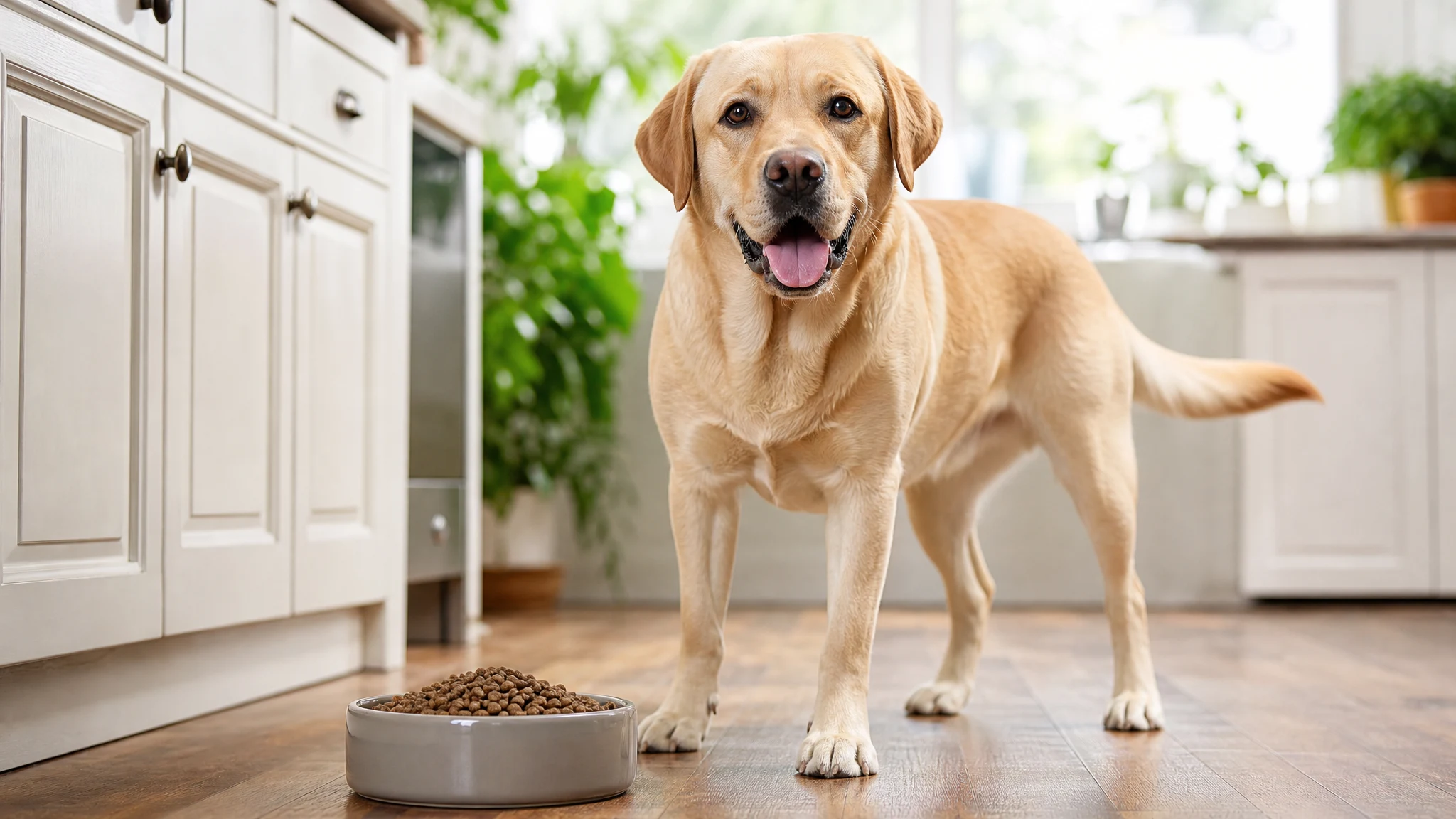
General nutrition information compiled from product labels and published sources, not veterinary advice. Your veterinarian is the right person to choose a diet for your dog, especially one with a health condition.
Shopping for dog food for black labs can feel like a puzzle. The bags are glossy, the claims are loud, and the real information is in small print on the back.
This guide shows you how to read that small print. The steps work for any Labrador Retriever, whatever the coat color. None of the brand label pages we compared sets feeding rules by coat color, so the choices that matter are life stage, size, calories and the AAFCO statement.
One note on method. We compared label data published on brand pages. We did not run feeding trials or taste tests, and nothing here says one food is better for your dog than another.
What You Need Before You Start
- The bag or the brand's product page for each food you are considering.
- Your Lab's age and current weight.
- A notepad or spreadsheet for notes on each food.
- A kitchen scale and a measuring cup, so you can follow a feeding guide.
- Your veterinarian's most recent comments on your dog's body condition.
Step 1: Know the Size You Are Feeding
The Labrador Retriever Club, the AKC parent club, lists adult males at roughly 65 to 80 pounds and females at roughly 55 to 70 pounds in working condition. The breed standard words the breed as medium-sized.
Pet food labeling draws its line at 70 pounds. Many male Labs sit at or above that line, so for puppy food it is safest to treat a Lab as a large-size dog.
Step 2: Find the AAFCO Statement
This is the most important sentence on the bag. It says whether the food is complete and balanced and for which life stage. Look for wording such as "for growth," "for maintenance" or "for all life stages."
It also tells you how the claim was backed up. Some statements say the food was formulated to meet AAFCO nutrient profiles. Others say animal feeding tests using AAFCO procedures substantiate the claim. Hill's Science Diet uses the feeding-test wording on its Large Breed adult and puppy pages. Royal Canin and VICTOR use the formulated-to-meet wording.
Neither wording is a quality ranking. It is simply what the company is claiming and how.
Step 3: Match the Life Stage
Puppies and adults need different foods, and the statement tells you which one you are holding.
Puppies
According to Whole Dog Journal, foods claiming growth or all life stages carry one of two phrases. One says "including growth of large-size dogs (70 pounds or more as an adult)," which fits a large-breed puppy. The other says "except for growth of large-size dogs," which does not.
Whole Dog Journal also notes that large and giant breed growth formulas cap calcium at 1.8 percent on a dry matter basis, and that large-breed puppies should not get supplemental calcium. Hill's lists calcium for its Puppy Large Breed recipe at 1.16 percent dry matter average, which is under that cap.
Two VICTOR labels show why this phrase matters. VICTOR's Hi-Pro Plus and its Chicken and Rice Formula Pate both except growth of large-size dogs. VICTOR's Hi-Pro Plus Large Breed Puppy includes it.
Adults and seniors
For adults, look for "maintenance" or "all life stages." Hill's makes a separate Adult 6+ Large Breed recipe for mature dogs. VICTOR's Senior Healthy Weight is an adult maintenance food, and VICTOR says it is not breed specific.
Step 4: Read the First Five Ingredients
Ingredients are listed by weight before cooking. The first five give a rough picture of what the food is built from.
A few reading tips:
- "Chicken" and "chicken meal" are different forms. Meal is the dried, concentrated form.
- "Chicken by-product meal" is a legal ingredient name. Read it as a description, not a verdict.
- "Grain free" is a marketing choice, not a health feature on its own. Of the foods we compared, only Nom Nom's Chicken Cuisine is listed as grain free.
Step 5: Compare Protein, Fat and Fiber Fairly
Be careful here. Some brands print guaranteed minimums and maximums. Hill's pages show dry matter averages instead. Fresh and canned foods contain a lot of water, so their percentages look tiny next to kibble.
Do not compare a fresh food's 6.5 percent protein with a kibble's 30 percent. They are measured on different bases. Compare like with like, or ask the brand for dry matter figures.
Step 6: Check Calories Per Cup
Labs are known for loving food, so calories matter. A Cell Metabolism study from 2016 (Raffan et al.) reported a gene deletion linked to obesity and food motivation. The reported frequency in Labradors was 12 percent, and it was more common in assistance dogs than in pets. The study does not say any food prevents or treats weight gain.
It does explain why many Labs act hungry all the time. Calorie density is worth knowing before you fill the cup.
Step 7: Put the Numbers Side by Side
Here is label data from the brand pages for a few Lab-relevant foods. Hill's protein, fat and fiber are dry matter averages. The rest are as published by each brand.
| Food | Life stage | Protein | Fat | Calories | First ingredients |
|---|---|---|---|---|---|
| Hill's Science Diet Adult Large Breed Chicken & Barley | Adult maintenance | 23.8% (dry matter avg.) | 15% (dry matter avg.) | 365 kcal per cup | Chicken, cracked pearled barley, brown rice |
| Hill's Science Diet Puppy Large Breed Chicken & Brown Rice | Growth, large breed | 26.7% (dry matter avg.) | 15.4% (dry matter avg.) | 387 kcal per cup | Chicken, brown rice, whole grain oats |
| Royal Canin Labrador Retriever Puppy | Growth, includes large-size dogs | 31.0% | 12.0% | 307 kcal ME per cup (calculated) | Chicken by-product meal, brewers rice, brown rice |
| VICTOR Hi-Pro Plus Large Breed Puppy | All life stages, includes large-dog growth | 30% | 14.0% | 365 kcal per cup | Chicken, chicken meal, brown rice |
| VICTOR Senior Healthy Weight | Adult maintenance | 27.0% | 11.5% | 360 kcal per cup | Beef meal, whole grain brown rice, whole grain millet |
Royal Canin also makes a Labrador Retriever Adult formula. The adult figures we found conflicted between listings, so check the numbers against the bag or with the brand.
Fresh options such as Nom Nom's Chicken Cuisine and JustFoodForDogs' Chicken & Rice Recipe state all life stages including growth of large-size dogs. Their feeding amounts come from each brand's own calculator.
For a wider look, see our label-by-label comparison of dog food for Labs.
Step 8: Treat the Feeding Guide as a Starting Point
Every feeding chart is a guess about an average dog. Royal Canin says its chart is only a guide and that amounts vary with temperament, activity and environment. Hill's says to adjust amounts to maintain optimal weight and to ask your veterinarian if unsure.
Weigh the food rather than eyeballing a scoop. Then ask your veterinarian how your Lab's body condition looks and adjust from there.
Step 9: Switch Foods Slowly
VICTOR's pages suggest moving between foods over 7 to 10 days. Royal Canin suggests at least 7 days. Mix a little of the new food into the old, and increase the share each day.
Tips and Common Mistakes
- Buying by coat color. A black Lab is not a different nutritional category on any label we read. Choose by age, size and body condition.
- Feeding an "except large-size dogs" food to a growing Lab. Read the exact growth phrase.
- Adding calcium to a puppy food. Whole Dog Journal advises against supplemental calcium for large-breed puppies.
- Comparing wet and dry percentages directly. Water content skews the numbers.
- Expecting a food to fix a health condition. The Labrador Retriever Club lists hip and elbow evaluations as recommended health clearances, but its page gives no diet guidance for them. Questions about joints, allergies or heart health belong with your veterinarian. Prescription diets are only something a veterinarian prescribes.
- Treating DCM headlines as settled. The FDA's last public update on its diet-associated DCM investigation was December 23, 2022. It said it does not plan further updates until there is meaningful new scientific information. Ask your veterinarian before changing foods over it.
What to Expect
If you follow these steps, you may end up with a short list of foods whose labels match your Lab's life stage and size. You may also find it easier to compare calories and ingredients across brands.
Over the weeks after a slow switch, many owners watch for steady energy, normal stools and a stable body weight. Those are things to discuss with your veterinarian. No label can promise a particular result for an individual dog.
Sources
- Labrador Retriever Club, Labrador Breed Standard
- Labrador Retriever Club, Health Issues
- Cell Metabolism 2016 (Raffan et al.), MRC Epidemiology Unit publications page
- FDA CVM, Investigation into Potential Link between Certain Diets and Canine DCM
- Whole Dog Journal, In the Fine Print: Nutritional Adequacy Statements
- Whole Dog Journal, Best Large Breed Puppy Food
- Hill's Pet Nutrition, Science Diet Adult 6+ Large Breed
- Nom Nom, Chicken Cuisine
- JustFoodForDogs, Chicken & Rice Recipe
- VICTOR, Hi-Pro Plus
- VICTOR, Chicken and Rice Formula Pate