Food for Labs Basics: What to Look For on the Label
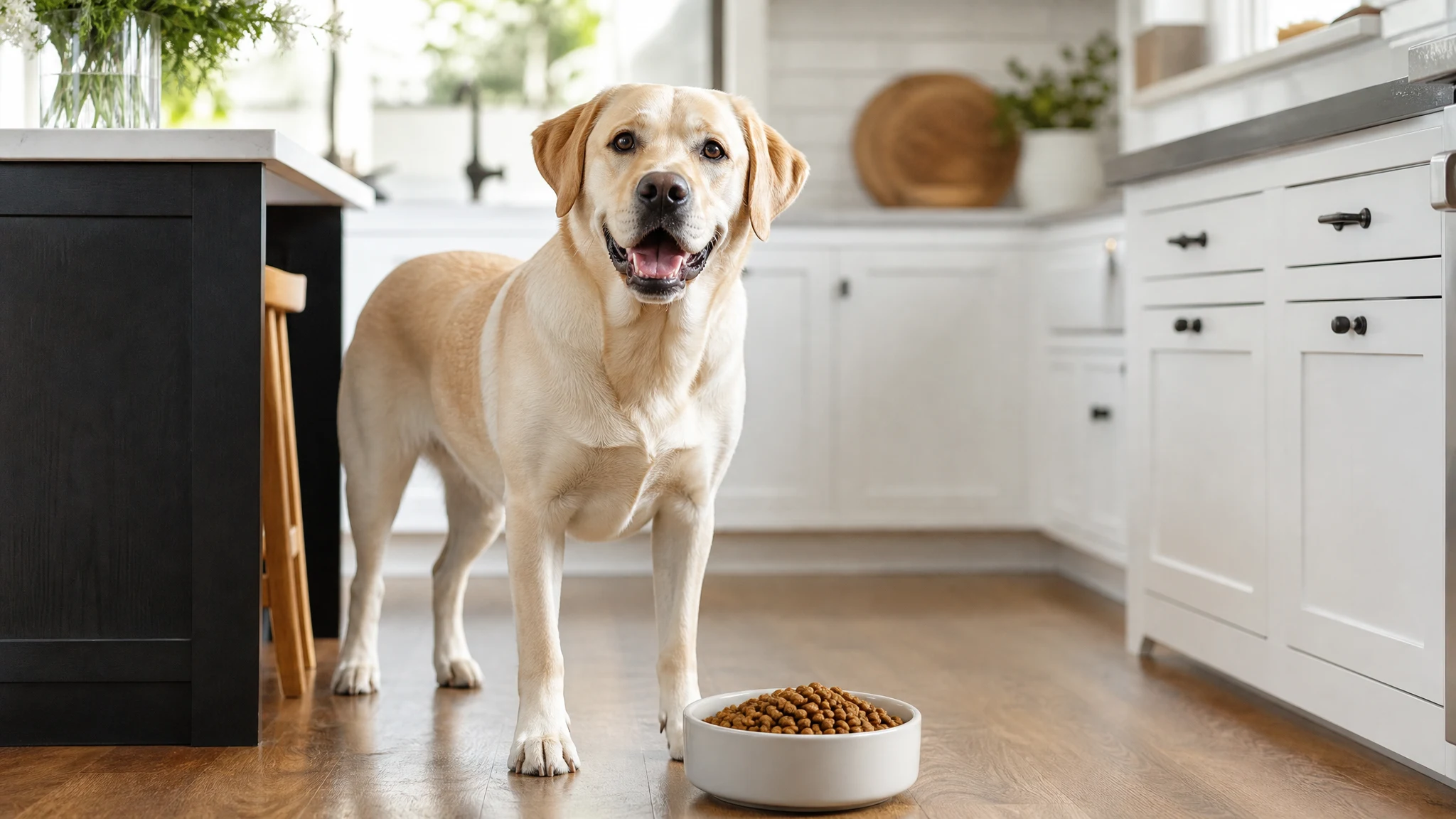
General nutrition information compiled from product labels and published sources, not veterinary advice. Your veterinarian is the right person to choose a diet for your dog, especially one with a health condition.
Choosing food for labs starts with the bag, not the front of it. The front shows photos and promises. The back shows the facts that can actually be compared.
This guide walks through the label of a dry, wet or fresh food one step at a time, using Labrador Retriever needs as the anchor. It is a reading method, not a ranking. We compared label data only. We did not run feeding trials or taste tests.
Why Labradors Need a Slightly Different Read
The Labrador Retriever Club (the AKC parent club) lists adult males at roughly 65 to 80 pounds and females at roughly 55 to 70 pounds in working condition. That puts many males at or above the 70 pound line that AAFCO uses to define a large-size dog on puppy food labels.
That one line matters most for puppies. Adults have an easier job: find a complete and balanced food and match calories to the dog.
Weight is a second Labrador theme. A 2016 study in Cell Metabolism (Raffan et al.), listed by the MRC Epidemiology Unit, reported a POMC gene deletion linked to obesity and food motivation. The study found the deletion in 12 percent of the Labradors it looked at, and more often in assistance dogs than in pets. In plain words, some Labs really do act hungry all the time. Calories on the label deserve extra attention.
Materials You Need
- The bag, can or pack of the food (or its brand product page, with the label panels shown).
- Your dog's current weight, age and activity level.
- A note of whether your Lab is a puppy, an adult or 6 and older.
- A measuring cup and a notepad or phone to record calories per cup.
- Your veterinarian's advice on body condition and any health concerns.
Step 1: Find the Nutritional Adequacy Statement
This is a small block of text, usually near the guaranteed analysis. It says whether the food is complete and balanced and for which life stage. Without it, the food is not a full diet.
The wording also tells you how the claim was backed up. Hill's Science Diet Adult Large Breed, for example, says animal feeding tests using AAFCO procedures substantiate complete and balanced nutrition for adult maintenance. Royal Canin's Labrador Retriever formulas say they are formulated to meet the AAFCO Dog Food Nutrient Profiles. Those are two different ways to support a claim. Both are on the label, and neither tells you how a particular dog will do.
Step 2: Match the Life Stage
Look for words like growth, maintenance, all life stages or adult 6+. A food for adult maintenance is not a puppy food. A puppy food fed for years can supply more calories than a settled adult needs.
Labels you will see for Labs include:
- Growth (puppy), such as Hill's Science Diet Puppy Large Breed, which lists growth up to 18 months.
- Adult maintenance, such as Hill's Science Diet Adult Large Breed.
- Mature adult, such as Hill's Science Diet Adult 6+ Large Breed.
Step 3: Check the Large-Size Growth Wording (Puppies Only)
This is the step most often missed. A food that claims growth or all life stages carries one of two phrases, according to Whole Dog Journal's explanation of adequacy statements:
- "including growth of large-size dogs (70 pounds or more as an adult)" means it is suitable for large-breed puppies.
- "except for growth of large-size dogs (70 pounds or more as an adult)" means it is not.
Whole Dog Journal also reports that large and giant breed growth formulas cap calcium at 1.8 percent on a dry matter basis, and that large-breed puppies should not get supplemental calcium. Ask your veterinarian before adding anything to a puppy's bowl.
Here is how real labels read. VICTOR Hi-Pro Plus Large Breed Puppy says its all life stages claim includes growth of large dogs. The standard VICTOR Hi-Pro Plus excepts growth of large dogs. VICTOR Chicken and Rice Formula Pate also excepts it. The names look similar, but the statements differ. Hill's lists calcium for its large breed puppy food at 1.16 percent dry matter average.
Royal Canin Labrador Retriever Puppy states it meets the AAFCO profiles for growth, including growth of large size dogs. It is described as a puppy food up to 15 months.
Step 4: Read the Calories Per Cup
Calories decide how much you pour, so write the number down. Here are the label figures we compared:
| Food | Stage on label | Calories |
|---|---|---|
| Hill's Science Diet Adult Large Breed | Adult | 365 kcal per cup |
| Hill's Science Diet Adult 6+ Large Breed | Mature adult | 352 kcal per cup |
| Hill's Science Diet Puppy Large Breed | Growth | 387 kcal per cup |
| Royal Canin Labrador Retriever Puppy | Growth | 307 kcal ME per cup (calculated) |
| VICTOR Hi-Pro Plus Large Breed Puppy | All life stages incl. large growth | 365 kcal per cup |
| VICTOR Senior Healthy Weight | Adult maintenance | 360 kcal per cup |
| VICTOR Hi-Pro Plus | All life stages except large growth | 406 kcal per cup |
| Nom Nom Chicken Cuisine (fresh) | All life stages incl. large growth | 244 kcal per cup (calculated) |
Cups are not equal across food types. A cup of fresh food and a cup of dense kibble are very different amounts. Compare calories, then compare how many cups each would take.
Step 5: Compare Protein and Fat Fairly
The guaranteed analysis lists minimum protein and fat and maximum fiber and moisture. Two traps show up here.
First, wet and fresh foods contain lots of water. Nom Nom Chicken Cuisine lists 6.5 percent protein, and VICTOR's pate lists 9.0 percent. Those numbers cannot be set next to a dry food's 30 percent without converting to dry matter.
Second, not every brand prints a guaranteed minimum. The Hill's pages we used show dry matter averages from an average nutrient table, such as 23.8 percent protein for the adult large breed recipe. Royal Canin Labrador Retriever Puppy lists a 31.0 percent minimum protein and 12.0 percent minimum fat. These are different kinds of numbers, so treat close comparisons with care. For guaranteed minimums on a specific Hill's product, check with the brand.
Step 6: Read the First Five Ingredients
Ingredients are listed by weight before cooking, so the first few give a rough picture. Notice the type of protein and the main carbohydrates.
- Hill's Adult Large Breed starts with chicken, cracked pearled barley, brown rice, brewers rice and whole grain wheat.
- Royal Canin Labrador Retriever Puppy starts with chicken by-product meal, brewers rice, brown rice, corn and wheat gluten.
- VICTOR Hi-Pro Plus Large Breed Puppy starts with chicken, chicken meal, brown rice, whole grain millet and whole grain sorghum.
- Nom Nom Chicken Cuisine is listed as grain-free and starts with chicken, sweet potatoes, squash, spinach and dicalcium phosphate.
An ingredient list shows what is in the food. It does not show quality or how a dog will respond. Words like "by-product meal" are not automatically bad or good. They are simply a fact to note and discuss with your vet if you are unsure.
Step 7: Use the Feeding Guide as a Starting Point
Every feeding chart is a guess based on average dogs. Hill's pages say to adjust amounts as necessary to maintain optimal weight and to ask your veterinarian if unsure. Royal Canin's guidance says amounts vary with temperament, activity level and environment.
Start at the label amount for your dog's ideal weight, not the current weight if it is above ideal. Then watch your dog's body shape and adjust with your vet.
Step 8: Check the Diet Questions That Need a Vet
The Labrador Retriever Club's health page lists hip and elbow evaluations among recommended health clearances. It gives no diet guidance for them. Labels and websites that suggest a food will prevent or treat joint problems, allergies or heart disease should be read skeptically. A veterinarian decides what is right for an individual dog, and prescription diets come only from a veterinarian.
The same goes for diet-associated dilated cardiomyopathy (DCM). The Labrador Retriever Club lists it as a research topic. The FDA's last public update on its investigation was December 23, 2022, and the agency said it did not plan further public updates until there is meaningful new scientific information. Ask your vet how this applies to your dog.
Tips and Common Mistakes
- Trusting the front of the bag. "Natural" and "premium" are not nutritional measures.
- Skipping the large-size growth phrase. This matters most for Lab puppies, especially males.
- Comparing wet and dry percentages directly. Convert to dry matter first, or compare calories.
- Ignoring treats. They add calories that the feeding chart does not count.
- Switching all at once. Royal Canin suggests at least 7 days for a transition, and VICTOR suggests 7 to 10 days.
- Trusting retailer listings blindly. Listings can differ from the brand. Royal Canin Labrador Retriever Adult figures varied between listings we saw, so check the numbers on your own bag.
- Assuming breed-named means better. A Labrador-named formula is still judged by the same label facts.
What to Expect
Reading labels this way can help you narrow a long shelf down to a few foods that fit your dog's life stage and size. It may also make calorie planning easier, which can support keeping a Lab at a healthy weight when combined with measured portions and your vet's guidance.
It cannot tell you how your dog will respond to a food. Stool quality, energy, coat and body condition are things to watch over several weeks, and your veterinarian can help you read them. Results vary from dog to dog.
To see how specific foods stack up on these same label points, read our label-by-label comparison of dog food for Labs.
Sources
- Labrador Retriever Club, Labrador Breed Standard
- Labrador Retriever Club, Health Issues
- MRC Epidemiology Unit, Cell Metabolism 2016 (Raffan et al.)
- FDA CVM, Investigation into Potential Link between Certain Diets and Canine DCM
- Whole Dog Journal, In the Fine Print: Nutritional Adequacy Statements
- Whole Dog Journal, Best Large Breed Puppy Food
- Hill's Science Diet Adult Large Breed
- Hill's Science Diet Adult 6+ Large Breed
- Hill's Science Diet Puppy Large Breed
- Royal Canin Labrador Retriever Puppy
- VICTOR Hi-Pro Plus Large Breed Puppy
- VICTOR Hi-Pro Plus
- VICTOR Senior Healthy Weight
- VICTOR Chicken and Rice Formula Pate
- Nom Nom Chicken Cuisine