Homemade Dog Food for Labs: What a Balanced Recipe Needs to Cover
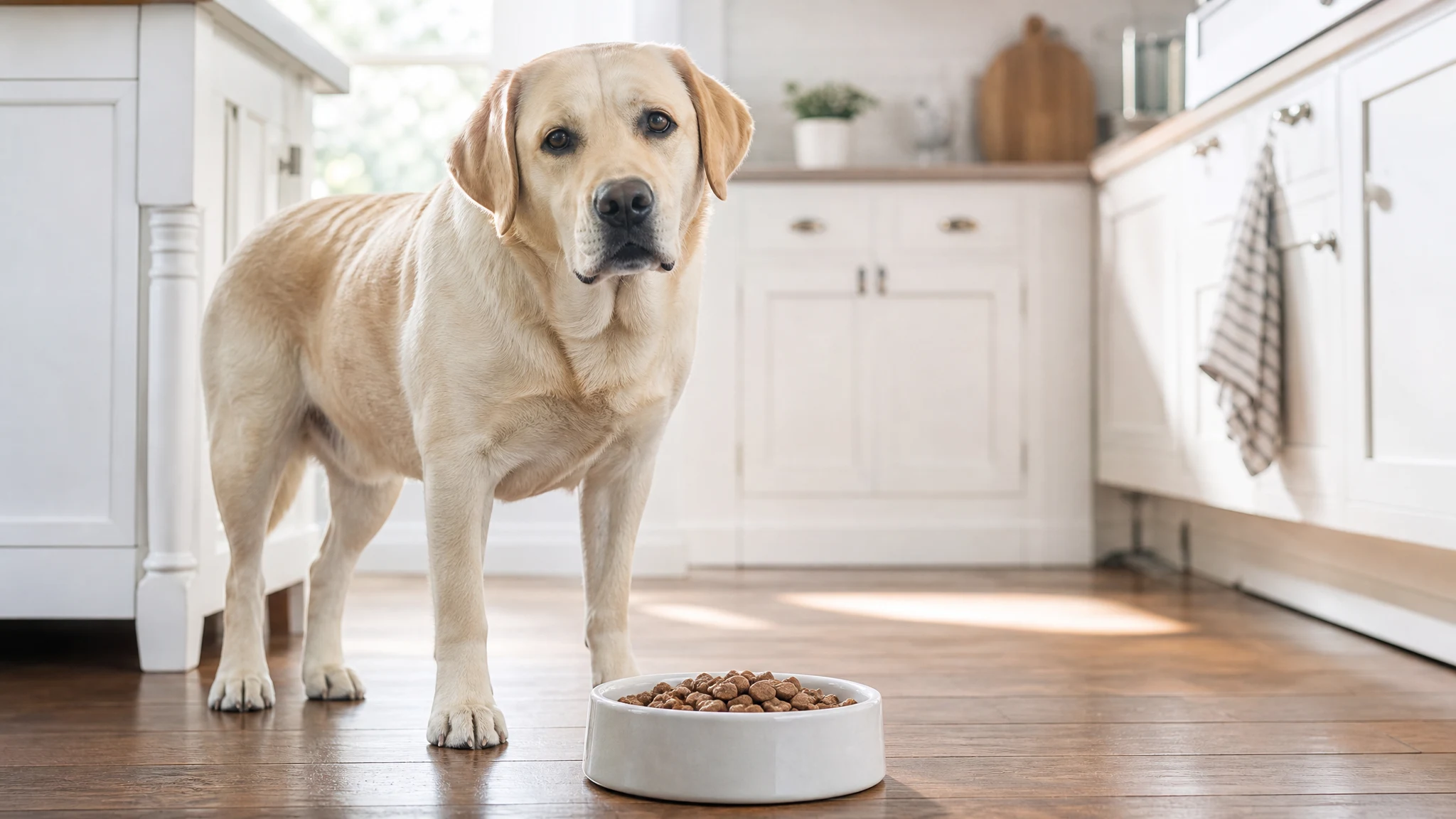
General nutrition information compiled from product labels and published sources, not veterinary advice. Your veterinarian is the right person to choose a diet for your dog, especially one with a health condition.
Many Lab owners think about cooking for their dog. The idea is appealing: you pick the ingredients and you know what went into the pot. The hard part is not cooking. It is making sure the finished meal is complete and balanced, day after day.
This guide walks through what a balanced homemade plan has to cover for a Labrador Retriever, and where a labeled commercial food may be the safer choice. We compared label data from brand pages. We did not run feeding trials or taste tests.
Why Labs need extra care with homemade meals
The Labrador Retriever Club, the AKC parent club, describes males at roughly 65 to 80 pounds and females at roughly 55 to 70 pounds in working condition. That puts many males at or above the 70 pound cutoff AAFCO uses for large-size dogs. This matters most for puppies.
Labs are also known for food motivation. A 2016 study in Cell Metabolism (Raffan et al.), listed by the MRC Epidemiology Unit, reported a POMC gene deletion in 12 percent of the Labradors studied. It was more common in assistance dogs than in pets. That is research on one gene, not a promise about any one dog. It is a reason to measure portions carefully rather than feed by eye.
The Labrador Retriever Club's health page lists hip and elbow evaluations among recommended clearances. It gives no diet advice for either. So no recipe should be presented as a fix for joint problems. Your veterinarian decides what an individual dog needs.
What you need before you start
- A written recipe from a source that formulates complete and balanced diets, ideally prepared with your veterinarian's input.
- A kitchen scale. Weigh ingredients in grams or ounces, not cups.
- Your dog's current weight and body condition, checked with your veterinarian.
- Whatever vitamin and mineral mix the recipe calls for. Use only the product and amount the recipe specifies. This article gives no doses.
- Food-safe containers and a freezer, so you can batch cook.
- A notebook to track meals, weight and stool quality.
Step-by-step: building a balanced homemade plan
Step 1: Decide the life stage you are feeding
A puppy, an adult and a senior Lab have different needs. AAFCO labels sort foods by life stage, such as growth, maintenance or all life stages. Start by naming which one your dog is in. If you are unsure, ask your veterinarian.
Step 2: Handle large-breed puppies with special care
Whole Dog Journal notes that large-breed puppies should eat a complete and balanced growth food labeled for large-size dogs. It says calcium should be capped at 1.8 percent on a dry matter basis, and that puppies should not get supplemental calcium.
That is hard to hit by guesswork in a home kitchen. For a growing Lab, a recipe built by a qualified formulator, or a food labeled for large-size growth, is the careful route.
Step 3: Get a recipe designed to be complete
Chicken, rice and vegetables alone are not a complete diet. A balanced plan has to cover protein, fat, calcium and phosphorus in proper proportion, plus vitamins, minerals and essential fatty acids. Recipes copied from blogs often leave gaps. Ask your veterinarian whether they can formulate or review a recipe, or refer you to someone who does.
Step 4: Weigh, do not eyeball
Weigh every ingredient. Swapping one protein or one vegetable for another changes the nutrient balance. Do not substitute without checking the recipe.
Step 5: Cook safely and batch it
Cook meat thoroughly, cool food quickly, and portion it into containers. Refrigerate what you will use soon and freeze the rest. Keep raw and cooked foods separate and wash surfaces and hands as you would for a family meal.
Step 6: Set calories, then portion
Work out daily calories with your veterinarian, based on your Lab's weight, age and activity. Divide that into meals. Treat any chart as a starting point, as the brand label guides do. Hill's, for example, says to adjust amounts to maintain optimal weight and to ask your veterinarian if unsure.
Step 7: Transition slowly
Royal Canin's guidance for its adult Labrador food is to transition gradually over at least 7 days. VICTOR suggests 7 to 10 days. The same slow pace is sensible when moving to a home-cooked diet.
Step 8: Track and recheck
Weigh your dog on a regular schedule. Feel the ribs and check the waist from above. Note appetite, stool and energy. Share these notes at veterinary visits so the plan can be adjusted.
How labeled foods compare on paper
A homemade diet has no AAFCO statement unless the whole recipe has been formulated and checked against the nutrient profiles. Labeled foods already carry one. The table below shows a few examples, using only figures printed on the brand pages.
| Food | AAFCO statement or life stage | Protein / fat | Calories | First ingredient |
|---|---|---|---|---|
| Royal Canin Labrador Retriever Puppy (dry) | Growth, including large-size dogs (70 lb or more as an adult) | 31.0% / 12.0% | 307 kcal ME per cup | Chicken by-product meal |
| VICTOR Hi-Pro Plus Large Breed Puppy (dry) | All life stages, including growth of large dogs | 30% / 14.0% | 365 kcal per cup | Chicken |
| Hill's Science Diet Adult Large Breed Chicken & Barley (dry) | Adult maintenance, feeding-test statement | 23.8% / 15% (dry matter averages) | 365 kcal per cup | Chicken |
| Nom Nom Chicken Cuisine (fresh) | All life stages, including growth of large-size dogs | 6.5% / 4.5% | 244 kcal per cup | Chicken |
| JustFoodForDogs Chicken & Rice (fresh, frozen) | All life stages, including growth of large-size dogs | 8.0% / 3.0% | 43 kcal ME per oz | Chicken |
Read this table with care. Hill's lists dry matter averages rather than guaranteed minimums. The fresh foods hold far more water, so their percentages cannot be compared directly with dry kibble. Kibble size is not listed on most of these pages, so check with the brand.
Brand pages: Royal Canin, VICTOR, Hill's, Nom Nom and JustFoodForDogs.
For a fuller side-by-side, see our label-by-label comparison of dog foods for Labs.
Tips and common mistakes
- Skipping the balance check. A meal that looks healthy to people can still be incomplete for a dog.
- Adding calcium to a puppy's meals. Whole Dog Journal says large-breed puppies should not get supplemental calcium.
- Using cups. Cup measures vary a lot. A scale is more reliable.
- Feeding by appetite. Labs often act hungry. Portion by plan, and count treats.
- Changing the recipe on a whim. Each swap can shift the nutrient balance.
- Assuming grain-free is better. The FDA has investigated a potential link between certain diets and canine dilated cardiomyopathy (DCM). Its last public update on that page was December 23, 2022, and it said it did not plan further updates without meaningful new scientific information. Talk with your veterinarian about your dog's diet instead of choosing by trend.
- Treating food as medicine. No home recipe or commercial food on this page is claimed to prevent or treat hip dysplasia, allergies, DCM or any other condition. Prescription diets come only from a veterinarian.
What results to expect
A carefully formulated and measured home diet may help you keep tighter control over what your Lab eats. It may also make portions easier to track. Results vary by dog, and no outcome is guaranteed. An unbalanced recipe, on the other hand, could leave nutrient gaps that show up slowly.
Watch for changes in weight, coat, stool or energy, and bring them to your veterinarian. Do not wait for a problem to be obvious.
When a labeled food may be the simpler choice
If you cannot get a vetted recipe, a labeled food with an AAFCO statement that fits your dog's life stage is a practical option. For puppies, look for wording such as "including growth of large-size dogs (70 pounds or more as an adult)". Avoid the "except for growth of large-size dogs" version, as Whole Dog Journal explains. Some VICTOR products carry that exception, so read the statement before buying.
Fresh and frozen foods from brands such as Nom Nom and JustFoodForDogs print a large-size growth statement on their pages. That is a label claim from the brand. We did not feed or test them.
Sources
- Labrador Retriever Club, Labrador Breed Standard
- Labrador Retriever Club, Health Issues
- Cell Metabolism 2016 (Raffan et al.), MRC Epidemiology Unit publications page
- FDA CVM, Investigation into Potential Link between Certain Diets and Canine DCM
- Whole Dog Journal, Best Large Breed Puppy Food
- Whole Dog Journal, In the Fine Print: Nutritional Adequacy Statements
- Hill's Pet Nutrition
- Royal Canin USA
- VICTOR Super Premium Pet Foods
- Nom Nom
- JustFoodForDogs