Wet vs Dry vs Fresh Food for Labs
General nutrition information compiled from product labels and published sources, not veterinary advice. Your veterinarian is the right person to choose a diet for your dog, especially one with a health condition.
Labrador Retriever owners get pulled in three directions: a bag of kibble, a stack of cans, or a box of fresh meals. Each form can be complete and balanced. They differ in water content, calories per cup, handling and cost.
This page compares the forms using the label data for a handful of real products. We compared label data only. We did not run feeding trials or taste tests, so nothing here is a claim about how a dog did on a food.
What a Lab needs from any form
The Labrador Retriever Club breed standard gives adult males as roughly 65 to 80 pounds and females as roughly 55 to 70 pounds. That puts many Labs at or above the 70 pound line that AAFCO uses for large-size dogs.
The line matters for puppies. Foods labeled for growth or all life stages carry one of two statements: "including growth of large-size dogs (70 pounds or more as an adult)" or "except for growth of large-size dogs." Whole Dog Journal explains that large-breed puppy formulas cap calcium at 1.8 percent of dry matter. A Lab puppy needs the "including" version, whichever form you choose.
Labs also have a food-motivation question. A study in Cell Metabolism (Raffan et al., 2016, listed by the MRC Epidemiology Unit) reported a POMC gene deletion linked to obesity and food drive. The deletion was found in 12 percent of the Labradors in the study, and it was more common in assistance dogs than in pets. Whatever you feed, calorie control matters for this breed, and the form changes how easy that is.
Wet vs dry dog food: the basics
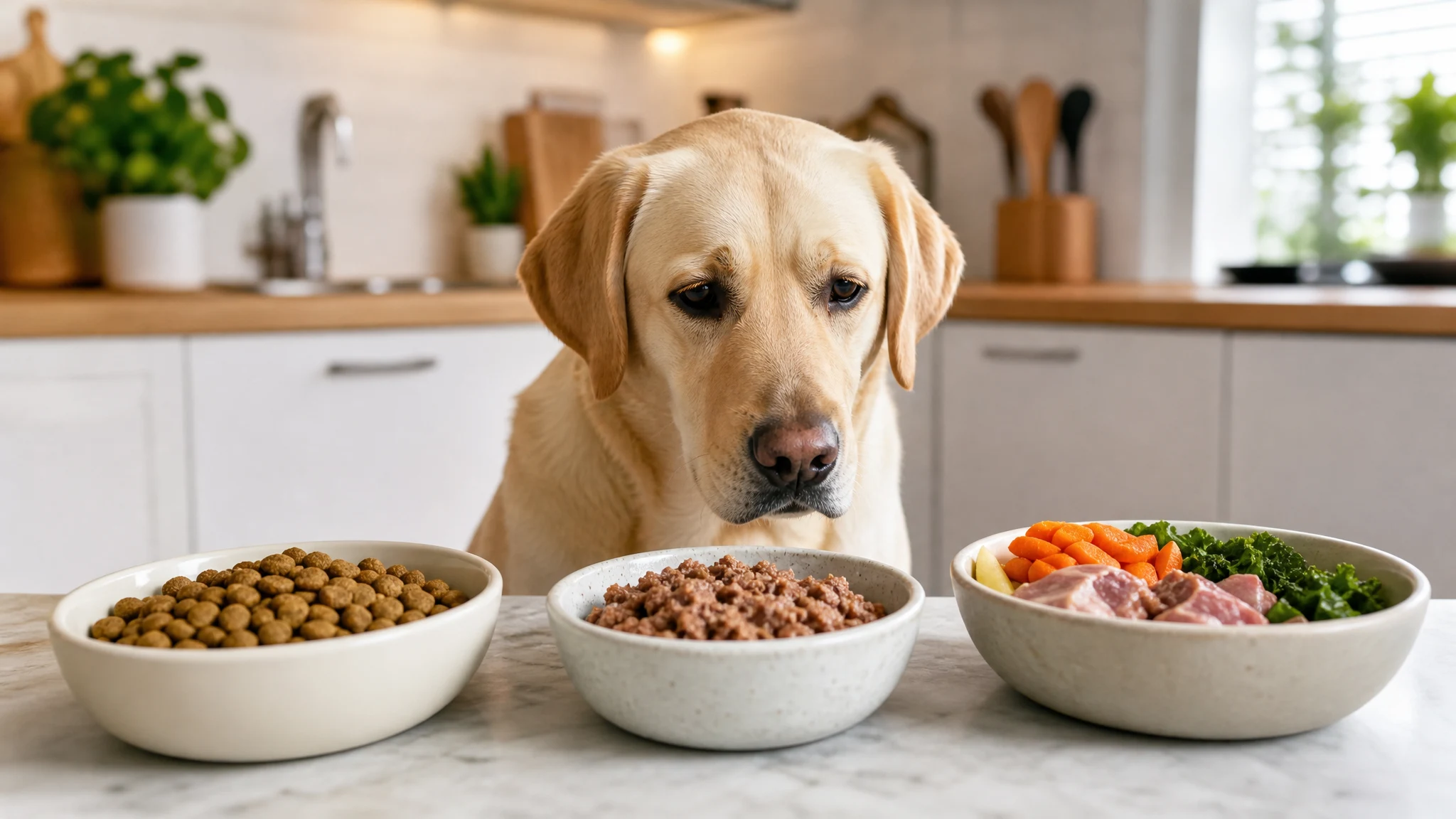
Dry food is kibble. Wet food, here meaning canned pate, is cooked and sealed in a can. Fresh food is lightly cooked, kept cold or frozen, and sold as meals. The product pages we read describe the forms this way:
- Dry: Hill's Science Diet large breed formulas, the Royal Canin Labrador Retriever Puppy formula, and several VICTOR recipes.
- Wet: the VICTOR Chicken and Rice Formula Pate.
- Fresh: Nom Nom Chicken Cuisine and the JustFoodForDogs Chicken & Rice Recipe (frozen).
For the full list of recipes, see our label-by-label comparison of Lab foods.
Side-by-side comparison
| Attribute | Dry | Wet (canned pate) | Fresh |
|---|---|---|---|
| Label examples | Hill's Science Diet Adult Large Breed; VICTOR Senior Healthy Weight | VICTOR Chicken and Rice Formula Pate | Nom Nom Chicken Cuisine; JustFoodForDogs Chicken & Rice |
| Energy on the label | 365 kcal per cup (Hill's Adult Large Breed); 360 kcal per cup (VICTOR Senior Healthy Weight) | 448 kcal per 13.2 oz can; no per-cup figure | 244 kcal per cup (Nom Nom, calculated); 774 kcal per 18 oz pack (JustFoodForDogs) |
| Protein as listed | About 27 to 31 percent minimum on several VICTOR and Royal Canin labels | 9.0 percent minimum | 6.5 percent (Nom Nom); 8.0 percent (JustFoodForDogs) |
| Water in the food | Lowest | High | High |
| Kibble size | Mostly not stated on the pages; Royal Canin Labrador formulas are described as donut-shaped, with no dimensions | Not applicable | Not applicable |
| Storage | Bag, room temperature | Room temperature until opened; refrigerate leftovers | Cold or frozen storage |
| Cost per day | Generally the lowest of the three | Generally higher than dry when it is the whole diet | Generally the highest |
Moisture and why the protein numbers mislead
The product pages we used do not list moisture percentages, so check the guaranteed analysis on the bag, can or pack for the exact figure. You can still see the effect of water in the protein numbers. The VICTOR pate lists 9.0 percent protein minimum, while VICTOR Hi-Pro Plus dry lists 30.0 percent. That does not mean the pate is a weak food. Most of its weight is water.
To compare across forms fairly, you need dry matter numbers, which remove the water from the math. Hill's lists dry matter averages on its pages, which makes its dry foods easier to compare with each other. Most other pages give as-fed percentages, so a wet-to-dry protein comparison is only a rough guide. Ask the brand for a dry matter breakdown if the comparison matters to you.
Calories per serving
For a breed known for big appetites, calories per cup is the number that matters most. The label data gives this spread:
- Hill's Science Diet Adult Large Breed: 365 kcal per cup.
- Hill's Science Diet Adult 6+ Large Breed: 352 kcal per cup.
- VICTOR Senior Healthy Weight: 360 kcal per cup.
- VICTOR Hi-Pro Plus: 406 kcal per cup, a high-calorie formula for active dogs.
- Nom Nom Chicken Cuisine: 244 kcal per cup, calculated.
Fresh food looks lighter per cup, but that is the water again. A cup of fresh food is not a cup of kibble, and swapping one for the other at the same volume will change the calories. VICTOR gives its pate energy per can, not per cup, and JustFoodForDogs gives it per pack, so those two cannot be lined up cup for cup.
Feeding amounts on these pages are starting points. Hill's says to adjust amounts to maintain optimal weight and to ask your veterinarian if you are unsure. The Royal Canin Labrador Retriever Puppy page points to a feeding calculator. Nom Nom and JustFoodForDogs also steer owners to a feeding guide or calculator. Use those as a first estimate, then adjust to your dog's body condition with your veterinarian.
Cost per day, in general terms
We are not quoting prices, because they change and the product pages we read do not give them. In general terms, dry food usually costs the least per day for a dog of Lab size. Wet food as the entire diet usually costs more, because you are paying for water, and a large dog needs many cans. Fresh food usually costs the most per day.
For a 70 pound dog, the gap adds up over a year. Check each brand's page for current pricing and portion sizes before deciding.
Dental myths
A common belief is that kibble cleans teeth and wet food ruins them. None of the sources we used make dental claims about these products, so we will not make them either. Be skeptical of any label or ad that implies a form of food replaces dental care. Ask your veterinarian about your own dog's teeth and what, if anything, to do about them.
Mixing forms
Mixing is common, such as kibble with a spoonful of wet or fresh food on top. It is fine as long as the calories are counted. If a topper adds calories, the kibble portion should come down, or a food-driven Lab will gain weight.
Two practical points from the brand pages:
- VICTOR advises moving between foods over 7 to 10 days.
- Nom Nom's guide for a 100 percent Nom Nom diet is a full-meal guide. If fresh is only part of the diet, ask the brand or your veterinarian how to split it.
For puppies, every part of the mix should be appropriate for large-size growth. VICTOR Hi-Pro Plus and the VICTOR Chicken and Rice Pate both carry an "except for growth of large size dogs" exception, so neither suits a Lab puppy as written on the page. Nom Nom Chicken Cuisine and JustFoodForDogs Chicken & Rice state that they include growth of large-size dogs.
Dry food: pros and cons
Pros
- Widest range of Lab-specific and large-breed recipes, including Hill's Science Diet large breed adult, mature and puppy formulas and the Royal Canin Labrador Retriever Puppy formula.
- Easy to measure and store.
- Generally the lowest cost per day.
Cons
- Calorie-dense, so a scoop that is slightly too big adds up quickly.
- Kibble size is missing on most of the pages we read, so check the bag.
- Less water in the bowl.
Wet food: pros and cons
Pros
- High water content and a soft texture.
- Handy as a topper or for a dog that eats slowly.
- Simple ingredient panels, such as chicken, broth, liver, brown rice and dried egg on the VICTOR pate.
Cons
- Costly as a full diet for a dog of Lab size.
- Opened cans need refrigeration.
- Our sources show only one wet product, and it is not for large-breed puppy growth.
Fresh food: pros and cons
Pros
- Both fresh labels we read state they include growth of large-size dogs.
- Recognizable ingredient lists, such as chicken, sweet potatoes, squash and spinach for Nom Nom.
- Lower calories per cup, which some owners find helps portion control. Weigh the calories, not just the cup.
Cons
- Usually the highest daily cost.
- Needs fridge or freezer space.
- Nom Nom Chicken Cuisine is labeled grain-free. The FDA has investigated a possible link between certain diets and canine dilated cardiomyopathy, and its last public update on that page was December 23, 2022. It said it did not plan further updates until there is meaningful new scientific information. Ask your veterinarian whether the question applies to your dog.
Best for: recommendations by use case
- Lab puppy: a food whose statement says it includes growth of large-size dogs. Dry examples are Hill's Science Diet Puppy Large Breed (calcium 1.16 percent dry matter average) and Royal Canin Labrador Retriever Puppy. Fresh examples are Nom Nom and JustFoodForDogs.
- Adult on a budget: dry, such as Hill's Science Diet Adult Large Breed.
- Mature adult, 6 and older: a large-breed mature formula such as Hill's Science Diet Adult 6+ Large Breed, or a weight-management formula such as VICTOR Senior Healthy Weight.
- Picky eater or low appetite: a wet or fresh topper, with calories counted.
- Convenience: dry.
- Weight problems: your veterinarian decides. The form matters less than the daily calories and a plan to measure them.
Verdict
For most Labs, a complete and balanced dry food that suits the dog's life stage is the practical default. The label data show the widest range of large-breed and Lab-specific recipes in dry form, and it is the easiest form to portion and the cheapest per day.
Fresh food is a legitimate choice for owners who can afford the daily cost and have the cold storage. The two fresh labels here state that they cover large-size puppies. Wet food works best as a topper or a partial meal.
None of these forms prevents or cures an illness. If your Lab has hip or elbow dysplasia, allergies, a heart concern or a weight problem, the Labrador Retriever Club's health page lists those conditions but gives no diet guidance for them. Your veterinarian decides what is right for an individual dog, including any prescription diet.
Sources
- Labrador Retriever Club, Labrador Breed Standard
- Labrador Retriever Club, Health Issues
- Cell Metabolism 2016 (Raffan et al.), MRC Epidemiology Unit publications page
- FDA CVM, Investigation into Potential Link between Certain Diets and Canine DCM
- Whole Dog Journal, In the Fine Print: Nutritional Adequacy Statements
- Hill's Science Diet Adult Large Breed
- Hill's Science Diet Puppy Large Breed
- Royal Canin USA, Labrador Retriever Puppy
- VICTOR Chicken and Rice Formula Pate
- VICTOR Senior Healthy Weight
- Nom Nom Chicken Cuisine
- JustFoodForDogs Chicken & Rice Recipe