How Much to Feed a Labrador Retriever: Feeding Chart by Age and Weight
General nutrition information compiled from product labels and published sources, not veterinary advice. Your veterinarian is the right person to choose a diet for your dog, especially one with a health condition.
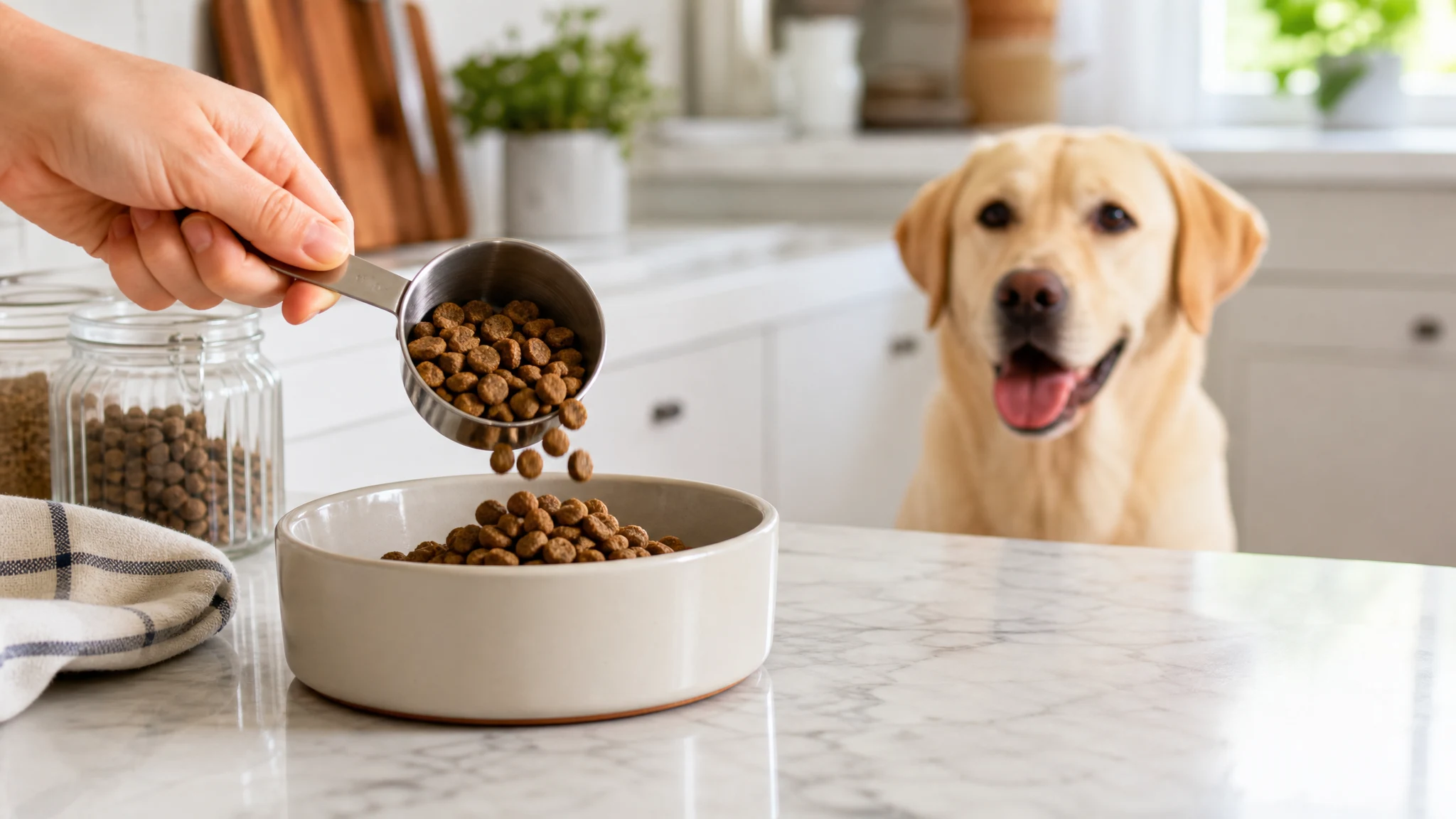
Working out how much to feed a Labrador Retriever is less about one magic number and more about a repeatable process. Start with the food's label guide, check your dog's body shape every couple of weeks, and adjust in small steps.
This article walks through that process. It also gives a Labrador Retriever feeding chart built from real label data, so you can see how much calorie content varies from one food to the next.
One point up front: every amount on a bag, and every figure below, is a starting point. A veterinarian sets the amount for an individual dog.
How we compared the labels
We compared label data published by each brand: the AAFCO statement, ingredients, calories per cup and the feeding notes. We did not run feeding trials or taste tests, and we did not feed any of these foods to dogs. Nothing here is a ranking or a recommendation of one food over another.
Some labels give a full feeding chart and others point to an online calculator. Where a chart or a number was not available to us, the table says so. Check the bag or the brand's page for the rest.
What you need before you start
- The bag, can or pack of the food you actually feed, with its nutritional adequacy (AAFCO) statement and calories per cup.
- A standard dry measuring cup, or a kitchen scale if your vet prefers weighing food.
- Your dog's current weight. A vet scale is the most reliable. A home scale works if you weigh yourself, then yourself holding the dog, and subtract.
- A notebook or phone note to log weight, amounts and body condition.
- A list of everything else your dog eats: treats, chews, training rewards, table scraps and food used to hide pills.
What size is a Labrador Retriever?
The Labrador Retriever Club, the AKC parent club, lists approximate working-condition weights in its breed standard. Males are 65 to 80 pounds and females are 55 to 70 pounds. Males stand 22.5 to 24.5 inches at the withers, and females 21.5 to 23.5 inches.
The standard calls the breed medium-sized. For puppy food labeling, though, the AAFCO large-size cutoff is 70 pounds or more as an adult. Males at 65 to 80 pounds sit around that line, so treat a Lab puppy as a large-size dog when you read puppy labels.
The breed standard does not give an age at which a Lab counts as an adult, and it does not give a life expectancy. The brands below set their own life-stage cutoffs, and your veterinarian can tell you when to switch for your dog.
Step 1: Pick the right life-stage food
The first thing on the label to check is the AAFCO statement. For a Lab puppy, this matters more than anything else on the bag.
According to Whole Dog Journal's explanation of nutritional adequacy statements, foods that claim growth or all life stages carry one of two phrases. One says "including growth of large-size dogs (70 pounds or more as an adult)." The other says "except for growth of large-size dogs." Only the first suits a large-breed puppy. Whole Dog Journal also reports that large-breed puppy foods cap calcium at 1.8% on a dry matter basis, and that large-breed puppies should not get supplemental calcium.
For adults, look for a statement of "maintenance" or "all life stages." Brands set their own age bands. Royal Canin's Labrador Retriever Puppy formula is for puppies up to 15 months, and its Labrador Retriever Adult formula is for purebred Labradors over 15 months. Hill's Science Diet lists its large breed adult food for dogs 1 to 5 years and its 6+ large breed food for mature adults.
Step 2: Read the calories per cup
Two foods can both say "1 cup" and deliver very different calories. That is why the same cup measure cannot be copied from one bag to another.
The table below uses the calorie figures and feeding notes published by each brand. It is a comparison of label data, not a prescription.
| Food (brand page) | Life stage on label | Calories per serving on label | What the label's feeding note says |
|---|---|---|---|
| Royal Canin Breed Health Nutrition Labrador Retriever Puppy (Royal Canin USA) | Growth, up to 15 months, includes large-size dogs | 307 kcal ME per cup as fed (calculated) | Points to a feeding calculator. The chart on the page is an image we could not read, so use the bag. |
| Hill's Science Diet Puppy Large Breed Chicken & Brown Rice (Hill's Pet Nutrition) | Growth, large breed puppies, up to 18 months | 387 kcal per cup | Adjust feeding amounts as necessary to maintain optimal weight. If unsure, ask your veterinarian. |
| VICTOR Hi-Pro Plus Large Breed Puppy (VICTOR) | All life stages, includes growth of large dogs | 365 kcal per cup | Feed as much as the puppy will eat in 20 minutes, across four intervals. Transition foods over 7 to 10 days. |
| Hill's Science Diet Adult Large Breed Chicken & Barley (Hill's Pet Nutrition) | Adult maintenance, ideal weight 55 to 110 lbs | 365 kcal per cup | Adjust feeding amounts as necessary to maintain optimal weight. If unsure, ask your veterinarian. |
| Hill's Science Diet Adult 6+ Large Breed Chicken Meal, Barley & Rice (Hill's Pet Nutrition) | Mature adult maintenance, 6+ years | 352 kcal per cup | Adjust feeding amounts as necessary to maintain optimal weight. If unsure, ask your veterinarian. |
| VICTOR Senior Healthy Weight (VICTOR) | Adult maintenance, senior, weight management | 360 kcal per cup | Has an adult weight reduction chart by body weight. Dogs over 100 lbs need an extra 1/2 cup for every 20 lbs. Switch foods over 7 to 10 days. |
| VICTOR Hi-Pro Plus (VICTOR) | All life stages except growth of large-size dogs | 406 kcal per cup | Adult guide starts at 1/2 cup daily for a 5 lb dog. For dogs over 100 lb, add 1/2 cup for every 20 lb above 100. |
| Nom Nom Chicken Cuisine, fresh (Nom Nom) | All life stages, includes growth of large-size dogs | 244 kcal per cup (calculated) | Use the Daily Feeding Guide for a full-meal diet. The guide lists 1 cup daily for a 10 lb adult dog. |
| JustFoodForDogs Chicken & Rice Recipe, fresh frozen (JustFoodForDogs) | All life stages, includes growth of large-size dogs | 43 kcal ME per oz; 774 kcal ME per 18 oz pack. No per-cup value given. | Offers a feeding calculator rather than fixed amounts. |
Note the spread. The label for Royal Canin's Labrador puppy food lists 307 kcal per cup, while the Hill's large breed puppy food lists 387 kcal per cup. A cup of one is not a cup of the other.
Two other points on the table. VICTOR's Hi-Pro Plus (the non-puppy version) and its Chicken and Rice Pate carry a statement that excludes growth of large-size dogs, so they are not labeled for Lab puppies. Also, the Royal Canin Labrador Retriever Adult formula is left out of the table. The adult figures we found for it conflicted between listings, so read the calories and feeding chart directly off the bag.
Step 3: Match the label guide to your Lab's weight
Most feeding charts are organized by body weight. Find your dog's current weight, not the weight you hope for, and read across to the suggested amount.
Here is a simple way to frame the chart for the breed. Using the breed standard's approximate weights, an adult female Lab falls roughly in the 55 to 70 pound rows and an adult male in the 65 to 80 pound rows. Those are breed averages, not targets. Plenty of healthy Labs sit outside them, and the right weight for your dog depends on frame and condition.
Read the chart as a daily total, then divide it into meals. If a chart gives a range, begin near the lower end for a calm, less active dog and the upper end for a very active one. Then move on to the next step before changing anything.
Some brands do not publish a fixed chart. JustFoodForDogs and Royal Canin point to calculators. Use them, and treat the answer as a starting point just like a printed chart.
Step 4: Score your Lab's body condition
The scale tells you weight, but it does not tell you whether that weight is carried as muscle or fat. Body condition scoring fills that gap. Many veterinarians use a nine-point scale where the middle of the range is ideal, and some use a five-point scale. Ask your vet which they use and what score they want for your dog.
You can check three things at home:
- Ribs. Run your hands along the sides of the chest. You should feel the ribs under a thin layer of padding without pressing hard. If you have to dig for them, your dog may be carrying extra weight. If they stick out sharply, your dog may be too lean.
- Waist. Look down from above. A dog at a healthy condition usually shows a visible waist behind the ribs.
- Belly tuck. Look from the side. The belly line should rise from the chest toward the hind legs rather than hang level or sag.
Labs have a thick, water-resistant double coat, so use your hands as well as your eyes. Photos taken from above every two weeks make slow changes easier to see.
Step 5: Adjust for age and activity
A label guide assumes an average dog. Your Lab may not be one.
- Puppies. Growth foods are made for steady, not fast, growth. Follow the large-breed puppy label closely and let your vet check the growth curve. Do not add calcium supplements, per Whole Dog Journal's large-breed puppy guidance.
- Active adults. A Lab that retrieves, swims or runs daily may need more than the middle of the chart. The Royal Canin Labrador adult feeding note says amounts may vary with temperament, activity level and environment.
- Calm or indoor adults. A Lab that mostly naps may need the lower end of the range.
- Mature dogs. Activity often drops with age. Hill's makes a separate 6+ large breed food at 352 kcal per cup, slightly lower than its 1-to-5-year formula. A vet can say whether your dog needs a change.
Change the daily amount by a small step, then wait two to four weeks and re-check weight and body condition before changing again. Quick swings are hard to read.
Step 6: Count treats, chews and extras
Training rewards, dental chews and bits of leftovers add calories that no feeding chart includes. If your dog gets many treats, ask your veterinarian how much of the day's food to trim. Using part of the regular kibble as training rewards is a simple way to keep the total steady.
Step 7: Switch foods slowly
If you change foods, VICTOR's labels suggest a transition of 7 to 10 days, and Royal Canin's Labrador adult notes suggest at least 7 days. Mix a little of the new food into the old and shift the ratio each day. Because calories per cup differ so much between foods, re-measure the portion rather than swapping cup for cup.
Why Labs deserve extra attention at the food bowl
Research gives one reason many Lab owners find their dogs intensely food motivated. A 2016 study in Cell Metabolism (Raffan et al.), listed by the MRC Epidemiology Unit, reported a deletion in the POMC gene in Labradors. The study found the variant in 12 percent of the Labradors it examined, and it was more common in assistance dogs than in pets.
That does not mean your dog has it, and it does not tell you what to feed. It is one reason a begging Lab is not proof that the bowl is too small. Rely on the scale and the body condition score, and bring concerns about constant hunger to your veterinarian.
The Labrador Retriever Club also lists hip and elbow evaluations among its recommended health clearances. Its health page gives no diet guidance for those conditions, and no food can be said to prevent or treat them. Questions about joints, weight and diet are for your veterinarian.
Diet-associated dilated cardiomyopathy (DCM) is also listed as a research topic on the parent club's health page. The FDA's most recent update on its DCM investigation was dated December 23, 2022, and it said it did not plan further public updates until there is meaningful new scientific information. If you have questions about your dog's food and heart health, ask your vet.
Common mistakes to avoid
- Feeding the same cups across brands. The table shows labels from 244 to 406 kcal per cup. Always use the chart on the food you are feeding.
- Using an adult formula for a large-breed puppy. Look for the "including growth of large-size dogs" wording.
- Measuring by eye or with a coffee mug. Use a real measuring cup or a scale.
- Ignoring treats. They count toward the day's total.
- Trusting the chart over the dog. If your Lab's ribs are hard to feel or the waist disappears, the guide is not working for this dog.
- Changing the amount too often. Give each adjustment a few weeks.
- Free-feeding. A bowl that is always full makes it hard to know how much your dog eats. Measured meals make changes easier to track.
- Putting an overweight dog on a diet without help. Ask your vet for a target weight and plan. Prescription diets are something only a veterinarian prescribes.
What results to expect
If you follow these steps, you may find it easier to keep your Lab at a steady weight with a visible waist and ribs you can feel. Many owners also notice more consistent energy and stools when they stop switching foods and portions often, though this varies from dog to dog.
No feeding plan can promise a particular outcome. Weight, appetite and growth depend on genetics, health, activity and the food itself. Use the changes in your dog's weight and body condition over several weeks as your guide.
Label guides are starting points. Take your log, the food label and your questions to your veterinarian, who sets the amount for an individual dog.
Sources
- Labrador Retriever Club (AKC parent club), Labrador Breed Standard
- Labrador Retriever Club, Health Issues
- Cell Metabolism 2016 (Raffan et al.), MRC Epidemiology Unit publications page
- FDA CVM, Investigation into Potential Link between Certain Diets and Canine DCM
- Whole Dog Journal, In the Fine Print: Nutritional Adequacy Statements
- Whole Dog Journal, Best Large Breed Puppy Food
- Hill's Science Diet Puppy Large Breed
- Hill's Science Diet Adult Large Breed
- Hill's Science Diet Adult 6+ Large Breed
- Royal Canin Labrador Retriever Puppy
- VICTOR Hi-Pro Plus Large Breed Puppy
- VICTOR Senior Healthy Weight
- VICTOR Hi-Pro Plus
- Nom Nom Chicken Cuisine
- JustFoodForDogs Chicken & Rice Recipe