Best Dry Food for Labs: Kibble Size and Texture
General nutrition information compiled from product labels and published sources, not veterinary advice. Your veterinarian is the right person to choose a diet for your dog, especially one with a health condition.
Choosing the best dry food for labs usually starts with the nutrition panel. Kibble size and texture get less attention, yet they shape how your Labrador Retriever eats every meal. This guide shows you how to check both, step by step, using only what the bag and the brand's own page tell you.
One honest note first. We compared label data. We did not run feeding trials or taste tests, and we are not ranking foods. For most products below, the brand pages do not publish kibble dimensions, so the last word on size belongs to the bag in your hands and to your veterinarian.
Why kibble size and texture matter for a Lab
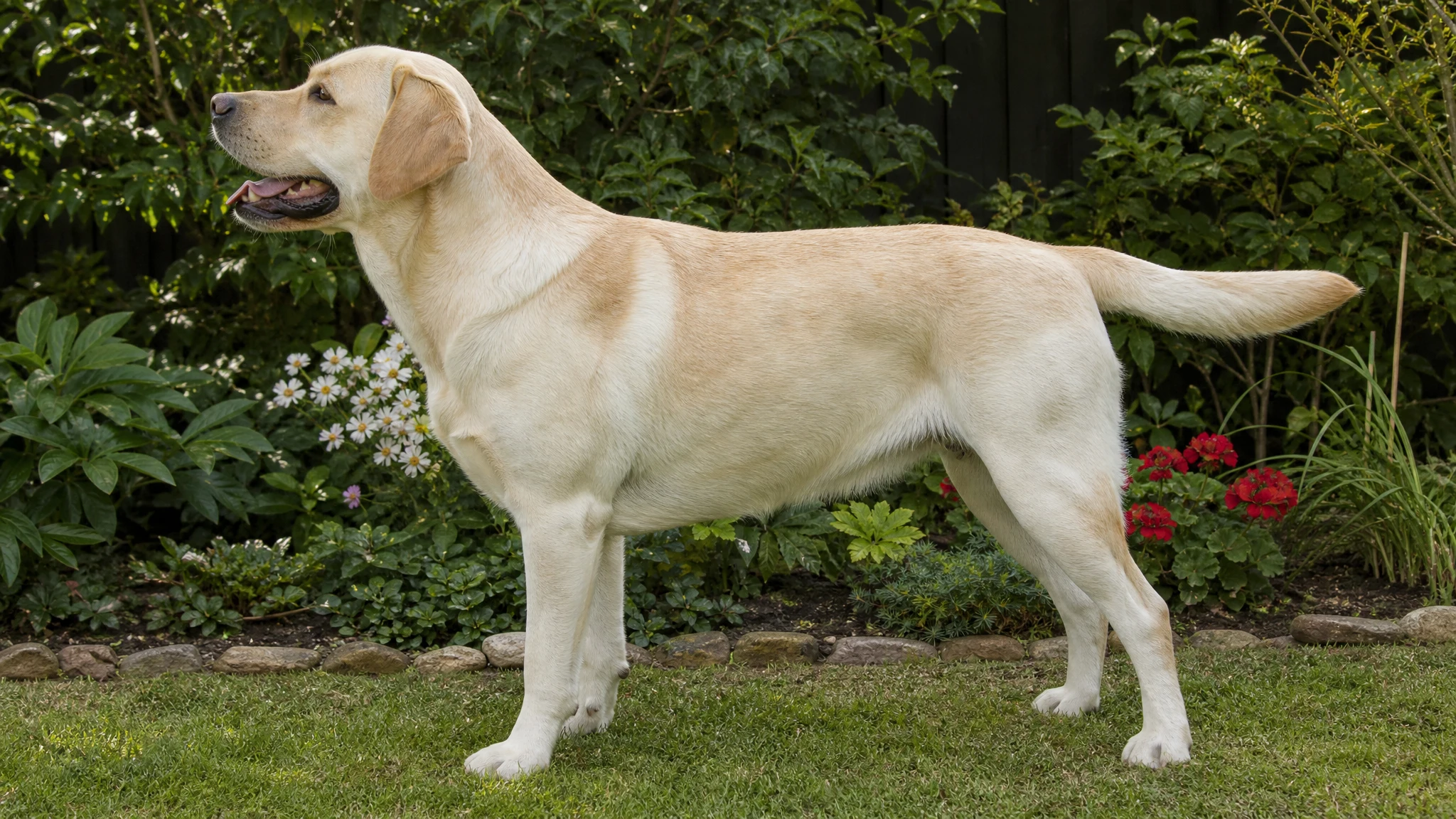
The Labrador Retriever Club, the AKC parent club, describes the breed standard as 65 to 80 pounds for males and 55 to 70 pounds for females, in working condition. That is a sturdy, medium-to-large dog with a strong appetite.
Research adds context. A 2016 study in Cell Metabolism (Raffan et al.), listed on the MRC Epidemiology Unit publications page, reported a POMC gene deletion in 12 percent of the Labradors studied. The deletion was more common in assistance dogs than in pets, and it is linked to food motivation and obesity.
Many Labs eat fast and with enthusiasm. That makes the physical form of the food worth a look. Nothing in these sources says a particular kibble shape changes health outcomes, so treat size and texture as practical feeding questions, not medical ones.
Materials you need
- The bag or the brand's product page for each food you are considering
- Your dog's current weight and age, and a note of whether you are feeding a puppy, an adult or a senior
- A kitchen scale or a marked measuring cup
- A notebook or phone note for comparing foods side by side
- Your veterinarian's number, for questions about your individual dog
Step 1: Confirm the life stage statement first
Before you think about shape, find the AAFCO statement on the bag. It tells you who the food is for. Everything else is secondary.
Whole Dog Journal explains that foods claiming growth or all life stages carry one of two wordings. One says the food is for growth "including growth of large-size dogs (70 pounds or more as an adult)." The other says "except for growth of large-size dogs." The second is not suitable for large-breed puppies.
The breed standard puts male Labs at or above that 70 pound line, so treat a Lab puppy as a large-size dog when reading labels. Whole Dog Journal also notes that large and giant breed growth formulas cap calcium at 1.8 percent on a dry matter basis, and that large-breed puppies should not get supplemental calcium. Ask your veterinarian about anything beyond the food itself.
Two examples from the brand pages show how this plays out:
- The VICTOR Hi-Pro Plus Large Breed Puppy page says its all life stages statement includes growth of large dogs.
- The VICTOR Hi-Pro Plus page says its statement excepts growth of large dogs, so it is not a puppy food for a Lab.
Step 2: Look for any size or shape description
Next, see what the brand says about the kibble itself. Here the published information is thin.
- The Royal Canin Labrador Retriever Puppy page describes a donut-shaped kibble but gives no dimensions.
- The VICTOR Hi-Pro Plus Large Breed Puppy page says the kibble size is appropriate for large breeds, with no measurement.
- The Hill's Science Diet pages for the Adult Large Breed, Adult 6+ Large Breed and Puppy Large Breed recipes do not state a kibble size that we could find.
If a page gives no size, do not assume one. Check with the brand, or compare the actual kibble once you have a small bag.
Step 3: Judge texture by what the label can tell you
Texture is hard to read from a label. A few clues help, and none of them is proof.
- Fiber. Crude fiber figures vary a lot. The Hill's Adult Large Breed page lists 1.7 percent (dry matter average), while the VICTOR Hi-Pro Plus Large Breed Puppy lists a 6.0 percent maximum. Different measurement bases are not directly comparable, so do not read these as a ranking.
- Fat. Fat affects how dense and calorie-rich each piece is. VICTOR lists 14.0 percent minimum fat for its large breed puppy food and 20.0 percent for Hi-Pro Plus.
- Ingredients. The first five ingredients on each brand page show the main building blocks, such as chicken, brown rice or barley.
Whether a piece is crunchy, dense or crumbly is something you learn by handling it. The label cannot tell you.
Step 4: Compare calories per cup, because pieces are not equal
A cup of small, dense kibble can hold more calories than a cup of larger, lighter pieces. Compare the calorie figure, not the volume.
| Food (dry) | Calories listed | Source |
|---|---|---|
| Hill's Science Diet Adult Large Breed | 365 kcal per cup | hillspet.com |
| Hill's Science Diet Adult 6+ Large Breed | 352 kcal per cup | hillspet.com |
| Hill's Science Diet Puppy Large Breed | 387 kcal per cup | hillspet.com |
| Royal Canin Labrador Retriever Puppy | 307 kcal ME per cup (calculated) | royalcanin.com |
| VICTOR Hi-Pro Plus Large Breed Puppy | 365 kcal per cup | victorpetfood.com |
| VICTOR Senior Healthy Weight | 360 kcal per cup | victorpetfood.com |
The Royal Canin adult Labrador figures conflicted between the listings we found, and we could not confirm them on the brand's own US page. Check the adult bag directly before you compare it.
Step 5: Use the feeding guide as a starting point
Every guide on these pages is a starting point. Hill's says to adjust feeding amounts as necessary to maintain optimal weight, and to ask your veterinarian if you are unsure. VICTOR's large breed puppy page suggests feeding as much as the puppy will eat in 20 minutes across four intervals, and switching foods over 7 to 10 days.
Given the food motivation reported in the Cell Metabolism study, measure meals rather than free-pouring. Weigh the portion on a scale where you can. The same cup scooped loosely or packed down can differ.
Step 6: Transition slowly and watch how your dog eats
Mix the new food with the old over 7 to 10 days, the window VICTOR gives on its pages. During that time, notice a few things:
- Does your Lab chew, or swallow pieces whole?
- Does the dog eat calmly, or gulp?
- Are stools and appetite steady?
If anything looks off, or you see repeated gulping, gagging or coughing, call your veterinarian. They decide what is right for an individual dog.
For the wider picture behind these steps, see our guide to the diet factors that matter for Labrador Retrievers.
Tips
- Compare two or three foods at a time, not ten.
- Buy the smallest bag first when a brand does not publish kibble dimensions.
- Use part of the daily kibble as training rewards, so treats do not add on top of it.
- Store kibble in a sealed container, and use the bag's own date and storage notes.
Common mistakes to avoid
- Choosing by shape alone. A donut or triangle is not a nutrition claim.
- Feeding an adult-only or "except large-size growth" food to a Lab puppy. Check the AAFCO wording.
- Adding calcium to a puppy diet. Whole Dog Journal advises against supplemental calcium for large-breed puppies.
- Switching all at once. A gradual change is what the brands recommend.
- Treating a food as a medical tool. The Labrador Retriever Club's health page lists hip and elbow evaluations as recommended clearances but gives no diet guidance for them. Diet and DCM is described there as a research topic. The FDA's most recent update on that investigation was December 23, 2022, and the agency said it would not issue further public updates without meaningful new scientific information. A veterinarian, not a bag, decides what an individual dog needs. Prescription diets are something only a veterinarian prescribes.
What to expect
Done carefully, these steps may help you narrow your options to a food that matches your dog's life stage and that your Lab eats comfortably. Some dogs may eat more slowly with a different piece size or shape, but results vary and the sources above make no such promise.
A food chosen this way may also make portions easier to measure and track. Keep your Lab at a lean, healthy weight, and check in with your veterinarian at routine visits.
Sources
- Labrador Retriever Club, Labrador Breed Standard
- Labrador Retriever Club, Health Issues
- Cell Metabolism 2016 (Raffan et al.), MRC Epidemiology Unit publications page
- Whole Dog Journal, In the Fine Print: Nutritional Adequacy Statements
- Whole Dog Journal, Best Large Breed Puppy Food
- FDA CVM, Investigation into Potential Link between Certain Diets and Canine DCM
- Hill's Pet Nutrition, Science Diet Adult Large Breed
- Royal Canin USA, Labrador Retriever Puppy
- VICTOR, Hi-Pro Plus Large Breed Puppy